‘In the beginning was the Word’ (John 1: 1-14) … pages from Saint John’s Gospel, the first complete hand-written and illuminated Bible since the Renaissance, in the Holy Writ exhibition in Lichfield Cathedral (Photograph: Patrick Comerford)
Patrick Comerford
Next Sunday, 7 February 2021, is the Second Sunday before Lent. This is Year B in the Revised Common Lectionary, when the readings are mainly from Saint Mark’s Gospel. The readings for next Sunday offer two options:
Option A, Creation: Proverbs 8: 1, 22-31; Psalm 104: 26-37; Colossians 1: 15-20; and John 1: 1-14;
Option B (Proper 3): Hosea 2: 14-20, Psalm 103: 1-13, 22, II Corinthians 3: 1-6, and Mark 2: 13-22.
The Revised Common Lectionary provides for a different set of readings for the Sunday between 4 and 10 February as the Fifth Sunday after the Epiphany: Isaiah 40: 21-31; Psalm 147: 1-11, 20c; I Corinthians 9: 16-23; and Mark 1: 29-39. However, in the Church of Ireland and the Church of England, these should not be used when the Second Sunday before Lent falls on this date (see The Book of Common Prayer 2004, pp 32-34; Common Worship, Lectionary, p 550; RCL, pp 438-444).
You we may find these choices difficult and puzzling at times, but this shows how important it is to plan readings and sermons, and therefore the hymns and intercessions, well in advance so you can avoid last-minute panics.
We have moved into Ordinary Time in the calendar of the Church (Photograph: Patrick Comerford)
Sundays in Season:
The Season of Christmas comes to an end not at Epiphany [6 January] and the end of the 12 days of Christmas, but 40 days after Christmas at the Feast of the Presentation or Candlemas, the great feast that falls tomorrow [2 February 2021].
The time between Candlemas and the beginning of Lent on Ash Wednesday has no season, and is known as Ordinary Time in the calendar of the Church. However, the two Sundays immediately before Lent have special themes, Creation and the Transfiguration, to help us prepare to mark appropriately the 40 days of Lent.
Option A:
The theme of the Option A readings on Sunday next, 7 February 2021, the Second Sunday before Lent, is Creation.
‘Before the mountains had been shaped, before the hills, I was brought forth’ (Proverbs 1: 25) … the Pyrenees on the borders of Spain and France (Photograph: Patrick Comerford, 2020)
Proverbs 8: 1, 22-31:
The first reading (Proverbs 8: 1, 22-31) reminds us that our own creation, the beginning of my own life, is irrevocably linked with the very beginning of Creation: ‘Before the mountains had been shaped, before the hills, I was brought forth’ (Proverbs 1: 25).
The Book of Proverbs is mostly instructions given by a scholar to a student, or a father to a son, on how to lead a moral life, with proper respect for God. Life involves choices, and it is important to be informed, trained and persuaded in order to be able to make the right choices.
Wisdom rejoices: ‘I was daily his delight, rejoicing before him always, rejoicing in his inhabited world and delighting in the human race’ (verses 30-31).
‘All things have been created through him and for him. He himself is before all things, and in him all things hold together (Colossians 1: 16-17) … Christ the Pantocrator in the dome of the parish church in Panormos in Crete (Photograph: Patrick Comerford, 2019)
Colossians 1: 15-20:
This link between Christ, the beginning of creation, and God’s plan for humanity within creation, is emphasised by the Apostle Paul in the New Testament reading (Colossians 1: 15-20):
15 He is the image of the invisible God, the firstborn of all creation; 16 for in him all things in heaven and on earth were created, things visible and invisible, whether thrones or dominions or rulers or powers — all things have been created through him and for him. 17 He himself is before all things, and in him all things hold together. 18 He is the head of the body, the church; he is the beginning, the firstborn from the dead, so that he might come to have first place in everything. 19 For in him all the fullness of God was pleased to dwell, 20 and through him God was pleased to reconcile to himself all things, whether on earth or in heaven, by making peace through the blood of his cross.
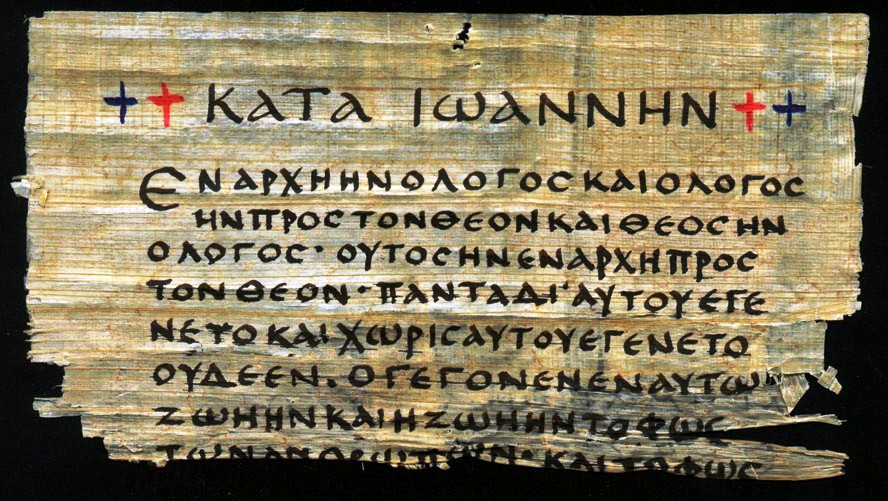
The Prologue in the opening chapter of Saint John’s Gospel is Greek mystical poetry of the highest quality
John 1: 1-14:
The opening verses of each of the four Gospels give us as readers initial clues to the interests that will govern the evangelists’ respective accounts of Christ’s life and ministry:
● Saint Matthew’s opening genealogy identifies Jesus as the descendant of both Abraham and David, as well as supplying his credentials as the Messianic king.
● Saint Mark’s opening is the most compact, recounting Christ’s baptism in order to establish his identity as the Son of God.
● Saint Luke’s introduction sets a detailed account of the announcements and actual births of both Saint John the Baptist and Jesus against the backdrop of the wider Roman world.
● Saint John’s makes the most dramatic use of the prologue form in shaping the contours of a particular Christological emphasis. This is probably one of the most profound passages in the Bible. As simple as its language and phrases are, its description of Christ as the Logos has had a lasting influence on Christian theology.
Sunday’s Gospel reading is familiar to many as the Gospel reading on Christmas morning, we may have heard the opening words of Saint John’s Gospel again at the beginnong of the year, on Second Sunday of Christmas (3 January 2021). The opening phrase, ‘In the beginning was the Word’ (Ἐν ἀρχῇ ἦν ὁ λόγος), is one of the most dramatic opening lines in any great work of literature. Indeed, the Fourth Gospel is one of the great works of literature, apart from being my favourite book in the Bible.
The author of this Gospel was identified by Saint Irenaeus as Saint John the beloved, Saint John the Divine, or Saint John the Theologian, who lived in Ephesus until the imperial reign of Trajan (ca AD 98).
As a boy, Irenaeus had known Saint Polycarp, who was Bishop of Smyrna, near Ephesus, and who is said to have been a disciple of John. Ever since then, the tradition of the Church has identified this John as the author of the Fourth Gospel.
The narrative translations with which we are so familiar often miss the poetic and dramatic presentations of this Gospel. We are all familiar with the dramatic presentation of the Prologue to this Gospel as the Gospel reading on Christmas Day. But the Prologue is first and foremost poetry. It is a hymn – a poetic summary – of the whole theology of this Gospel, as well as an introduction to it.
Raymond Brown has presented a translation from the Greek of the Prologue in poetic format:
1 In the beginning was the Word;
the Word was in God’s presence,
and the Word was God.
2 He was present with God in the beginning.
3 Through him all things came into being,
and apart from him not a thing came to be.
4 That which came to be found life in him,
and this life was the light of the human race.
5 The light shines on in the darkness,
for the darkness did not overcome it.
(6 Now there was a man sent by God, named John 7 who came as a witness to testify to the light, so that through him all might believe – 8 but only to testify to the light, for he himself was not the light.)
9 He was the real light
that gives light to everyone;
he was coming into the world.
10 He was in the world,
and the world was made by him;
yet the world did not recognise him.
11 To his own he came;
yet his own people did not accept him.
12 But all those who did accept him,
he empowered to become God’s children –
those who believe in his name,
13 those who were begotten,
not by blood,
nor the flesh,
nor human desire,
but by God.
14 And the Word became flesh
and made his dwelling among us.
And we have seen his glory,
the glory as of an only Son coming from the Father,
rich in kindness and fidelity.
‘The light shines in the darkness, and the darkness did not overcome it’ (John 1: 5) … a winter sunrise at the Rectory in Askeaton, Co Limerick (Photograph: Patrick Comerford)
The first chapter of the Gospel according to Saint John can be divided in two parts: the Prologue (verses 1-18) and a second part (verses 19-50) that shows that John the Baptist was preparing for the coming of the Messiah.
The Prologue is an introduction to the Gospel as a whole. It tells us that the Logos is God and acts as the mouthpiece (Word) of God ‘made flesh,’ sent to the world in order to be able to intercede for humanity and to forgive human sins.
The Prologue is of central significance to the doctrine of the Incarnation. The Prologue can be compared with Genesis 1, where the same phrase, ‘In the beginning …,’ first occurs along with the emphasis on the difference between the darkness and the light.
The Prologue prepares the reader for the rest of the Fourth Gospel. Important themes are signalled and Christ’s identity is established at the very outset through the use of Christological titles, divine portents or the manner of his birth.
Saint John’s Gospel is the only Gospel to speak of Christ’s pre-existence as the Logos and the only Gospel to include a poetic prologue.
The Prologue provides a profound and highly developed theological summary that has a structural integrity of its own, while also introducing many of the key themes of the Gospel account that follows.
Section 1: Verses 1-5
Verses 1-2:
While the focus of the Prologue is on God in relation to humanity, rather than God in relation to Himself, the first two verses are the closest to an intra-Trinitarian description in this Gospel.
The ‘Word’ here is difficult to separate from the language of Genesis 1, with its echoes of ‘in the beginning’ and a creative ‘Word’ which calls all things into being. The phrase ‘in the beginning’ could also combine both a temporal sense – in the beginning of history – and a cosmological sense, ‘at the root of the universe.’
The opening verses leave little doubt that the Logos is identified as being equal in divine status to God, and is fully God, so that what will be said about the Logos will be said, in the fullest sense, of God.
Verses 3-5:
The remainder of this first section (verses 3-5) is introduced by πάντα (panta), a Greek word that figures prominently in several other New Testament hymn-like passages (see Romans 11: 36; I Corinthians 8: 6; Colossians 1: 16). These passages – all of them Pauline – describe the comprehensive character of Christ’s work of redemption. The phrasing of verse 3 is best seen as an expansion of the activity of the Logos in creation, with the restatement in verse 3b emphasising the all-inclusive character of the involvement of the Logos.
The word ζωὴ (zoe, life) is one of those terms in John that is laden with meaning. Although the sense of ‘eternal life’ may seem difficult to apply here, a consideration of the creational basis for this concept makes it quite acceptable, for the Logos is from the beginning and the source of all life (see Genesis 2: 7, 9; 3: 22; and Revelation 22: 2). There is a close connection between life and light in the giving and sustaining of life (John 8: 12; see Psalms 13: 3; 27: 1; 56: 13; 89: 15).
How should verse 5 be translated? The NIV translates the verb καταλαμβάνω (katalambáno) as ‘understood’: ‘and the darkness has not understood it.’ However, the NEB, Brown and others speak of ‘mastering’ or ‘overcomin’” the darkness. Despite the fall, the work of the Logos did not end but instead continued.
Section 2: Verses 6-13
Verses 6-9:
Are these verses out of place here? Do they disrupt the poetic flow?
Many commentators, including Brown, see these verses as an explanatory insertion that should be placed after the Prologue and before verse 19. Brown says one of the main purposes of the Fourth Gospel is to counter a sectarian group that regarded Saint John the Baptist as the Messiah, or at least as being equal to him – an intention emphasised in these verses, and further developed later in this chapter.
Verse 9 also draws attention once again to the theme of ‘light.’ Although the description of the light as ‘true’ (ἀληθινόν, alethinon) may seem puzzling at first, as there is no reference in the Fourth Gospel to a ‘false’ or ‘lesser’ light, there is a well-established tradition in Judaism in which the Torah is symbolised by light, with which the writer may be contrasting the final and true, real and eternal revelation of God’s light.
Verses 10-13 (verses 10-12b):
Verses 10 to 12b have been understood in different ways. If the passage is read as referring to the Old Testament presence of the Logos among his people (whether in the Torah or through prophets and leaders), it forms a chronological bridge between the Creation strophe of verses 1-5 and the Incarnation reported in verse 14. Yet such a reading would interrupt the chronological sequence of the Prologue, since John the Baptist has already been mentioned in verses 6-8.
CH Dodd argues that the Old Testament sometimes identifies the people of Israel as the ‘children’ or ‘son’ or ‘sons’ of God (see Deuteronomy 14: 1; Psalm 82: 6; Hosea 1: 10; Hosea 11: 1).
But this could also be an initial reference to the career of Jesus of Nazareth, so that verses 10-12b parallel the career of Jesus, providing a short summary of both the Book of Signs (chapters 2-12) in verse 11, and the Book of Glory (chapters 13-20) in verse 12.
It could be argued that the writer has a dual purpose, referring at on e and the same time to both the relationship of the Logos with creation and Israel, and to its Incarnation in the ministry of Christ.
The word κόσμος (kosmos), first introduced in verse 9, is now explained further, in a resumption of the staircase poetic structure from verses 1-5. The word is repeated three times, in order to explain that the creation in verse 3 (particularly the human domain of that creation) painfully and inexplicably rejected the Logos on his appearance. This lack of recognition, not ‘seeing,’ by some in Jesus’ audience, is an important theme later in the Gospel (see John 9: 35-41; 11: 9, 40; 12: 37-45; and also 1:14).
Verses 10-13 (verses 11-13):
The remainder of the middle section expands on this theme and narrows the focus of the ‘rejection’ motif. The term ‘his own’ (ἴδια, idia, idioi) is used in two senses: the first reference in the neuter plural (‘his own things,’ NRSV; ‘that which was his own,’ NIV) refers in a general way to the place which he has made, the creation; and the second use is in the masculine plural – ‘his own (people)’ – either humanity (verses 3, 4) or, more specifically, Israel – who were brought into being through him (II Samuel 5: 2, Psalm 33: 12; Isaiah 1: 3; Jeremiah 31: 33).
But Christ’s coming will not be met with complete rejection. The section concludes on the note of hope, emphasising the possibility for those who believe to be born anew and recreated through the same God who brought all of creation into being. The triple negative construction in verse 13 (‘not of blood or of the will of the flesh or of the will of man,’ NRSV; ‘not of human descent, nor of human decision, nor a husband’s will’) heightens the contrast between conventional, natural processes of the created world, and the newness which Christ’s ministry brings into the world (see John 3: 3-8).
The term ‘believe in,’ πιστεύουσιν εἰς (pisteuein eis) in verse 12, is typically Johannine and appears almost 40 times in this Gospel, most often in connection with Christ (31 times), and usually in reference to saving faith. Those who believe in the Son will form a new community of people who will be ‘his own,’ in contrast to those who – although they were already his own – did not recognise or believe in him.
Brown and others see verse 13 as an editorial expansion of the original hymn. They point to a differing style and its focus on the believer, in contrast to the Logos-centred emphasis of verses 1-5, 10-12 and 14.
Section 3: Verses 14-18:
The reading for Sunday next continues into the first verse of the third section of the Prologue, verse 14.
Verse 14
The final section of the Prologue draws together the different elements introduced up to now. Attention now shifts to the centrality of the Incarnation and its implications. For the first time since verse 1, the term Logos is restated, emphasising the movement from its cosmological dimensions in verse 1 to the temporal experience and conviction of the present Johannine community.
This movement is also apparent in the writer’s use of the verb ‘to become’ (γίνομαι, ginomai) in place of ‘to be.’ In this way, he signals that the Word has taken on a new form in a dramatic way.
This language could be a flat rejection of any sort of Docetism.
Paradoxically, the Word that was fully God is now completely ‘flesh’ (σὰρξ, sarx), but both are equally true. There is a similar parallel between ‘was with God’ (in verse 1b) and ‘made his dwelling among us’ (verse 14b). The verb used here – ‘to make one’s dwelling’ (σκηνόω, skenoo) – draws on the Exodus traditions of a God who once lived among his people in the Tabernacle (see Exodus 33) and made his glory visible to his people there (Exodus 40: 34; see I Kings 8: 11). This theme was continued in prophetic literature, including Joel, Zechariah and Ezekiel, and is a theme in the entire story of God’s covenant with Israel.
The important concept of ‘glory’ (δόξα, doxa) is introduced here. This is another of the special terms in the Fourth Gospel, where it occurs 35 of the 185 times it is found in the New Testament. It is deeply rooted in the Old Testament, where the Hebrew concept of kabod embodies the dual sense of God’s ruling divinity made visible through observable actions of great power.
For Saint John, this glory is visible in Christ’s statements and signs, many of which fulfil or supersede important elements in the Old Testament. But it is most evident in Christ’s death, resurrection, and ascension.
There is a close link here between σκηνόω (skenoo) and δόξα (doxa): ‘the Word … dwelt among us, and we have seen his glory.’ This may allude to the fulfilment of the ‘new covenant’ promises regarding the coming nearness of God to his people in a way that will replace both Tabernacle and Temple.
The word μονογενοῦς (monogenous) has long been translated ‘only begotten,’ an expression linked closely to Trinitarian procession theology. Recently, it has also come to be seen in terms of Christ’s unique relationship with the Father, emphasising obedience and faithfulness to his purpose.
The couplet ‘grace and truth’ (χάριτος καὶ ἀληθείας, charitos kai aletheias; also in verse 17) echoes the Hebrew pairing of ‘steadfast love’ and ‘truth,’ which are central in the covenantal self-disclosure of God in the Old Testament. For a third time, the writer is using terminology that has important significance in Exodus (see Exodus 34: 6) and that is used throughout the Old Testament covenant. He is telling us he is going to present Christ to the reader as the fulfilment of God’s previous revelation to Israel and of the hope of a second Exodus revelation.
‘The light shines in the darkness, and the darkness did not overcome it’ (John 1: 5) … light pours into the darkness in Saint Barbara’s Church, Rethymnon, in Crete (Photograph: Patrick Comerford)
Conclusion:
The Prologue lays the foundation for the development of the ‘realised eschatology’ of the Fourth Gospel. When Saint John speaks later of life in the sense of ‘eternal’ life, the Prologue has already established that from the beginning in Christ the eternal God and source of life is present and is among men and women for that purpose. In Christ, God enters into all the ambiguities, difficulties, and trials of human life. He comes to live among his people as one of them, revealing God at first hand, and offering new life as the source of life from the beginning.
The writer relates the Logos in turn to God (verses 1, 2); creation (verses 3-5); the world and its response (verses 6-9); his own people (verses 10, 11); his children (verses 12-13); a specific circle of disciples and witnesses (verse 14); and later in the Prologue to a particular historical person, Jesus Christ (verse 17). Finally, in verse 18, the intimacy of the relationship of the Logos to the Father is re-emphasised in language similar to that used in John 13: 23-25 to describe the intimacy between ‘the beloved disciple’ and Christ himself.
The Prologue is a model and a summons to us to think carefully and deeply about the implications of the Incarnation and to apply this concept in all its comprehensive ways to our life and our world. For all its broad, cosmic scope, the Prologue presents a direct and personal question to readers of all times: will the one who reads believe, and share in the fullness of grace given by the One who has come from the Father to dwell among us?
‘In the beginning was the Word’ (John 1: 1) … an old typewriter seen in a restaurant in Limerick (Photograph: Patrick Comerford)
John 1: 1-14 (NRSVA):
1 In the beginning was the Word, and the Word was with God, and the Word was God. 2 He was in the beginning with God. 3 All things came into being through him, and without him not one thing came into being. What has come into being 4 in him was life, and the life was the light of all people. 5 The light shines in the darkness, and the darkness did not overcome it.
6 There was a man sent from God, whose name was John. 7 He came as a witness to testify to the light, so that all might believe through him. 8 He himself was not the light, but he came to testify to the light. 9 The true light, which enlightens everyone, was coming into the world.
10 He was in the world, and the world came into being through him; yet the world did not know him. 11 He came to what was his own, and his own people did not accept him. 12 But to all who received him, who believed in his name, he gave power to become children of God, 13 who were born, not of blood or of the will of the flesh or of the will of man, but of God.
14 And the Word became flesh and lived among us, and we have seen his glory, the glory as of a father’s only son, full of grace and truth.
Option B (Proper 3):
Waiting for the banquet … Hosea compares the new covenant to a new wedding (Photograph: Patrick Comerford)
Hosea 2: 14-20:
The prophet Hosea uses marriage as a metaphor to describe the relationship between God and Israel, in which God is the husband and Israel the wife. She has succumbed to worshipping Canaanite gods, including Baal, and has come to see these pagan gods rather than God as the source of basic necessities (verse 4).
So, God will take the fertility of the land away from the people. Israel will be shown to be the whore she is, and she will be punished for worshipping Baals (verse 13).
However, this is not God’s final decision. He will ‘allure’ her back to the wilderness (verse 14), a place where she can again make contact with him, as he did during the Exodus. He will care for her, and he will again bless her with good vineyards or harvests (verse 15). Israel will again he fruitful and will be rejuvenated. On that day, she will become his partner and will no longer be in servitude. God will remove the temptation to worship pagan deities, will make a new covenant with all living things and abolish warfare, and so protect his people.
This marriage will be forever, and the signs of the dowry will be righteousness, justice, steadfast love, mercy and faithfulness (see verse 20).
‘For as the heavens are high above the earth, so great is his mercy upon those who fear him’ (Psalm 103: 111) … blue skies and clouds reflected in the waters of Kenmare Bay at Templenoe on the Ring of Kerry (Photograph: Patrick Comerford, 2020)
Psalm 103: 1-13, 22:
The psalmist praises God for all he has done, and he gives thanks for the healing that is a sign of God’s forgiveness and the restoration of a good relationship with God.
God is just to the oppressed, merciful and loving to all who fear him, is slow to anger and is forgiving. He is like a father who knows our frailty, who loves those who are faithful to him; he rules over all, so we should honour the Lord and all he has created.
‘You yourselves are our letter, written on our hearts, to be known and read by all’ (I Corinthians 3: 2) … old family letters (Photograph: Patrick Comerford)
II Corinthians 3: 1-6:
Because the Apostle Paul has not visited the Christians at Corinth as they expected, their trust in him has diminished. He seeks to restore this trust. He reminds them that they need to realise that, unlike other preachers, he does not use God’s word for financial gain, but offers it freely, with sincerity and as an emissary of God.
But Saint Paul is cautious, and he reminds them that they are no longer dependent on the old law but are in a new covenant, and that living in the Spirit leads to eternal life.
Waiting for dinner … Christ dines with people whose trades make them social outcasts (Photograph: Patrick Comerford)
Mark 2: 13-22:
Christ is in Capernaum, on the western shore of the Sea of Galilee. He has told a paralytic man that his sins are forgiven, but some religious authorities doubt his ability to do this, saying only God can forgive sins. He has proved that he is from God by also healing the man.
Tax collectors were considered unclean ritually, they worked for the occupying power and they were suspect financially. As with Peter and Andrew, Christ sees Levi the tax collector beside the sea, and he responds immediately to Christ’s call to follow him. Is this the same person as Matthew (see Matthew 9:9), the author of the first Gospel?
Christ dines with people whose trades that made them ritually unclean and social outcasts. When the religiously powerful question his actions, Christ replies that he comes to call and to invite into his Kingdom those in need of repentance, not those who think they are righteous in God’s eyes.
In his answer, Christ uses the metaphor of marriage between God and his people, which we came across the reading from the Prophet Hosea. Christ is the bridegroom and his followers are the wedding guests. The feast is in progress, so this is a time for joy, while after his death it will be a time for fasting. He insists that the old way of being and the new way he brings are separate, even if both are to be valued. New material stretches more than old. When wine ferments, it expands. Soft new wineskins expand with the wine, but old ones do not.
‘The Feast in the House of Levi’ (1573), Paolo Veronese (1528-1588), Galleria della Academia, Venice
Mark 2: 13-22 (NRSVA):
13 Jesus went out again beside the sea; the whole crowd gathered around him, and he taught them. 14 As he was walking along, he saw Levi son of Alphaeus sitting at the tax booth, and he said to him, “Follow me.” And he got up and followed him.
15 And as he sat at dinner in Levi’s house, many tax collectors and sinners were also sitting with Jesus and his disciples – for there were many who followed him. 16 When the scribes of the Pharisees saw that he was eating with sinners and tax collectors, they said to his disciples, “Why does he eat with tax collectors and sinners?” 17 When Jesus heard this, he said to them, “Those who are well have no need of a physician, but those who are sick; I have come to call not the righteous but sinners.”
18 Now John’s disciples and the Pharisees were fasting; and people came and said to him, “Why do John’s disciples and the disciples of the Pharisees fast, but your disciples do not fast?” 19 Jesus said to them, “The wedding guests cannot fast while the bridegroom is with them, can they? As long as they have the bridegroom with them, they cannot fast. 20 The days will come when the bridegroom is taken away from them, and then they will fast on that day.
21 “No one sews a piece of unshrunk cloth on an old cloak; otherwise, the patch pulls away from it, the new from the old, and a worse tear is made. 22 And no one puts new wine into old wineskins; otherwise, the wine will burst the skins, and the wine is lost, and so are the skins; but one puts new wine into fresh wineskins.”
A wedding at Sidney Sussex College, Cambridge … Christ uses the metaphor of marriage between God and his people, in which Christ is the bridegroom and his followers are the wedding guests (Photograph: Patrick Comerford)
Liturgical resources:
Liturgical colour: Green (Ordinary Time).
Collect:
Almighty God,
you have created the heavens and the earth
and made us in your own image:
Teach us to discern your hand in all your works
and your likeness in all your children;
through Jesus Christ our Lord,
who with you and the Holy Spirit
reigns supreme over all things, now and for ever.
Post Communion Prayer:
God our creator,
by your gift the tree of life was set at the heart
of the earthly paradise,
and the Bread of life at the heart of your Church.
May we who have been nourished at your table on earth
be transformed by the glory of the Saviour’s Cross
and enjoy the delights of eternity;
through Jesus Christ our Lord.
‘The light shines in the darkness, and the darkness did not overcome it’ (John 1: 4) … light in the darkness in the courtyard in Marlay Park, Dublin (Photograph: Patrick Comerford, 2020)
Suggested hymns:
Option A, Creation:
Proverbs 8: 1, 22-31:
84, Alleluia! raise the anthem
Psalm 104: 26-37:
346, Angel voices, ever singing
42, Good is the Lord, our heavenly King
356, I will sing, I will sing a song unto the Lord
357, I’ll praise my maker while I’ve breath
6, Immortal, invisible, God only wise
305, O Breath of life, come sweeping through us
Colossians 1: 15-20:
643, Be thou my vision, O Lord of my heart
220, Glory be to Jesus
160, Hark! the herald-angels sing
522, In Christ there is no east or west
94, In the name of Jesus
431, Lord, enthroned in heavenly splendour
303, Lord of the Church, we pray for our renewing
7, My God, how wonderful thou art
103, O Christ the same, through all our story’s pages
306, O Spirit of the living God
675, Peace, perfect peace, in this dark world of sin?
John 1-14:
146, A great and mighty wonder
84, Alleluia! raise the anthem
87, Christ is the world’s light, he and none other
259, Christ triumphant, ever reigning
160, Hark! the herald-angels sing
427, Let all mortal flesh keep silence
195, Lord, the light of your love is shining
172, O come, all ye faithful
175, Of the Father’s heart begotten
491, We have a gospel to proclaim
Option B (Proper 3):
Hosea 2: 14-20:
528, The Church’s one foundation
Psalm 103: 1-13, 22:
1, Bless the Lord, my soul
686, Bless the Lord, the God of our forebears
688, Come, bless the Lord, God of our forebears
349, Fill thou my life, O Lord my God
33, O Lord of every shining constellation
366, Praise, my soul, the king of heaven
365, Praise to the Lord, the Almighty, the King of creation
660, Thine for ever! God of love
47, We plough the fields and scatter
374, When all thy mercies, O my God
II Corinthians 3: 1-6:
382, Help us, O Lord to learn
306, O Spirit of the living God
Mark 2: 13-22
218, And can it be that I should gain
608, Be still and know that I am God
549, Dear Lord and Father of mankind
417, He gave his life in selfless love
418, Here, O my Lord, I see thee face to face
94, In the name of Jesus
584, Jesus calls us! O’er the tumult
130, Jesus came, the heavens adoring
605, Will you come and follow me
‘The light shines in the darkness, and the darkness did not overcome it’ (John 1: 4) … the River Lee at night in Cork (Photograph: Patrick Comerford, 2020)
Scripture quotations are from the New Revised Standard Version Bible: Anglicised Edition copyright © 1989, 1995, National Council of the Churches of Christ in the United States of America. Used by permission. All rights reserved worldwide. http://nrsvbibles.org
Material from the Book of Common Prayer is copyright © 2004, Representative Body of the Church of Ireland.
The hymn suggestions are provided in Sing to the Word (2000), edited by Bishop Edward Darling. The hymn numbers refer to the Church of Ireland’s Church Hymnal (5th edition, Oxford: OUP, 2000).
‘The light shines in the darkness, and the darkness did not overcome it’ (John 1: 4) … evening lights at Knightstown on Valentia Island, Co Kerry (Photograph: Patrick Comerford, 2020)
Continuing Ministerial Education in the Diocese of Limerick, Killaloe and Ardfert
Showing posts with label 2 before Lent. Show all posts
Monday, 1 February 2021
Monday, 10 February 2020
Readings, hymns and
sermon ideas for
Sunday 16 February 2020,
Second Sunday before Lent
‘Even Solomon in all his glory was not clothed like one of these’ (Matthew 6: 29) … a peacock in a vineyard in Rivesaltes in France (Photograph: Patrick Comerford, 2018)
Patrick Comerford
Next Sunday, 16 February 2020, is the Second Sunday before Lent.
The readings in the Revised Common Lectionary, as adapted for use in the Church of Ireland, offer two choices:
The Readings: Option A, Creation: Genesis 1: 1 to 2: 3; Psalm 136 or Psalm 136: 1-9 (23-36); Romans 8: 18-25; Matthew 6: 25-34.
There is a link to each reading through the highlighted citation.
The Readings: Option B, Proper 3: Isaiah 49: 8-16a; Psalm 131; I Corinthians 4: 1-5; Matthew 6: 24-34.
There is a link to the readings HERE.
A cautionary note:
There is considerable confusion about the lectionary readings for next Sunday. At the time of preparing these notes for publication, the relevant page on the Church of Ireland website provides the wrong readings, the wrong propers and the wrong suggested hymns. In addition, some editions of the Revised Common Lectionary are difficult to follow, and it is difficult to disentangle them and find the preferred options in the Church of Ireland.
The best advise, normally, is to follow the Table of Readings in the Book of Common Prayer (2004) (see pp 27-70; for next Sunday, see 33), checking against the Church of Ireland Directory and the newly-published book of collects.
This posting, hopefully, clarifies any remaining questions about the appropriate readings to use next Sunday.
for convenience and ease of access, the notes and reflections on the Gospel reading are repeated in the notes on each option.
Sunset at the harbour in Skerries, Co Dublin … next Sunday may be observed as Creation Sunday (Photograph: Patrick Comerford, 2018)
Introducing the Readings (Option A, Creation):
The three Sundays before Lent once had special Latin names in the Book of Common Prayer, names that were shared in most traditions in the Western Church. Although these Sundays are now counted as ‘Ordinary Time’ in many traditions, many Anglican parishes still use the original Latin names, and they are reminders that Lent and its disciplines are imminent.
These Sundays were known as:
Septuagesima Sunday: the Third Sunday before Lent, which fell this year on Sunday 9 February 2020. In the early Church, no Gloria or Alleluia was sung on this Sunday because this was the first Sunday of the call to Lenten discipline. Although the word Septuagesima means ‘seventieth’, this Sunday occurs only 63 days before Easter.
Early Christians began observing Lent the day after Septuagesima Sunday. This is because Thursdays, Saturdays and Sundays were not days of fasting in the early Church. So, if the faithful wished to fast for 40 days before Easter, they would start the Monday after Septuagesima Sunday. Today, only Sunday is a non-fast day, and so Lent begins on Ash Wednesday.
Sexagesima Sunday: the Second Sunday before Lent, which is next Sunday (16 February 2020). In the Early Church, Lent would have started on the previous Monday. In some parts of the Eastern Orthodox church, this Sunday is known as ‘No Meat Sunday,’ and the dietary observances for Lent begin on this day.
Quinquagesima Sunday: the final Sunday before Lent, or the Sunday before Ash Wednesday (23 February 2020). It is 50 days before Easter, hence quinquagesima or ‘fiftieth.’
In some part of the Anglican Communion, the Sundays after Epiphany and before Lent continue to be counted as Sundays after Epiphany. However, the calendar in the Church of Ireland is much clearer in liturgical terms, counting the days between Christmas and the Presentation (Candlemas) as one, 40-day season, and the days after Candlemas not as Sundays after Epiphany but as Sundays before Lent.
Next Sunday has two options in the Calendar of the Church of Ireland. In the first option, it can be marked as ‘Creation Sunday,’ although many churches now mark the Sundays in September as the Creation Sunday. In the second option, it can be marked as the Second Sunday before Lent, continuing the themes in the Lectionary readings, which in Year A are drawn mainly from Saint Matthew’s Gospel.
With a growing awareness about climate change and the threats to God’s creation – emphasised by recent weather fluctuations, including the storms of the past weekend, the firestorms in Australia, and the debates about carbon emission and climate change in the recent election campaign – the Creation option next Sunday offers an interesting opportunity to preach about these concerns and to make them relevant in our parishes.
Care for the creation is neither a marginal theological consideration, nor a matter of keeping up with current social and political trends. The fifth of the Five Marks of Mission accepted throughout the Anglican Communion is:
● To strive to safeguard the integrity of creation, and sustain and renew the life of the earth.
‘In the beginning God created the heavens and the earth’ (Genesis 1: 1) … ‘on the seventh day he rested from all his work’ (Genesis 2: 2) ... sunrise at Igoumenitsa in northern Greece (Photograph: Patrick Comerford, 2019)
Genesis 1: 1 to 2: 3:
The first reading in our readings celebrating creation, is a poetic description of God’s creation, reaching its climax or fulfilment in describing God’s creation of humanity and God’s relationship with us.
Ancient cultures and religions in Mesopotamia and the Middle East shared a common creation story, similar to the creation story in Genesis, with a similar sequence of events. There is a second Creation narrative in Genesis 2: 4b-25, and the Bible closes with the account of a new creation, a new heaven and a new earth, in the Book of Revelation (see Revelation 21 and 22).
Like all good stories, this story begins at the beginning: ‘In the beginning when God created the heavens and the earth’ (Genesis 1: 1). In other words, God pre-exists all creation, God exists before all time, and the whole visible creation comes into being as a result of God’s activity.
At first, there was chaos, ‘an empty, formless void’ (verse 2). However, the life-giving power of God, the ‘wind’ or Spirit ‘from God’ sweeps over this chaos. The creation story is then told in the form of a poem or hymn, with a refrain, ‘And God saw that it was good’ (verses 4, 10, 12, 18, 20, 25).
Day 1 (verses 3-5): God creates light, overcoming the darkness. By naming them light and darkness, God is said to be in control of both.
Day 2 (verses 6-10): God creates the sky, which acts like a bowl above the earth, with water (rain and snow), and the waters that surround the dry land (seas, lakes and rivers). Again, God names them.
Day 3 (verses 11-13): God creates the trees, plants, fruit and vegetables.
Day 4 (verse 14-19): God creates the Sun and the Moon. In Biblical times, they were seen as beings moving in a circle around the dome of the earth, according to God’s command.
Day 5 (verses 20-23): God creates the creatures in the sea and the air, fish, birds, and even ‘the great sea monsters.’
Day 6 (verses 24-31): God creates the creatures on the land, wild and domestic animals, including snakes and insects.
Then God says, ‘Let us’ (26), invoking a royal we. The creation of humanity is the climax of the creation story. We are made in God’s image – the Hebrew word used here implies an exact copy or reproduction. Because of God’s blessing, we have procreative power, we are to be fruitful and multiply, and to have dominion over the earth, acting as God’s regents, with means taking responsibility for a just rule in and care for the creation.
And we are told that not only that ‘God saw that it was good’ – as on the other days of creation – but, ‘indeed, it was very good’ (verse 31).
Day 7 (Genesis 2: 1-3): The seventh day is the day of rest, a reminder of the Sabbath. God blesses the seventh day, and God sets it apart or makes it holy.
Notice how there is no evening at the end of this day – this relationship between God and humanity is to continue for ever, to the end of the story (see Revelation 21 and 22).
‘For his mercy endures forever’ (Psalm 136) … the polyelaios in the cathedral in Rethymnon, Crete (Photograph: Patrick Comerford, 2019)
Psalm 136:
Psalm 136 could be complemented at Morning Prayer and Evening Prayer with the canticles ‘Great and Wonderful’ (Canticle 17, Book of Common Prayer, p 129), based on Revelation 15: 3, 4 and 5: 13b, and ‘Glory and Honour’ (Canticle 21, Book of Common Prayer, p 131), based on Revelation 4: 11 and 5: 9, 10 and 13b.
In the Eastern Orthodox tradition, Psalms 135 and 136 are known together as the Polyeleos (Πολυέλεος) or ‘Many Mercies,’ because of the refrain ‘for his mercy endures forever’ (ὅτι εἰς τὸν αἰῶνα τὸ ἔλεος αὐτοῦ).
The Polyeleos is sung at Orthros or Matins on a Feast Day and at Vigils, and in the monasteries on Mount Athos it is read every Sunday at Orthros.
Indeed, on Mount Athos it is considered one of the most joyful periods of Matins-Liturgy, and the highest point of Matins. In Athonite practice, all the candles are lit, and the chandeliers are made to swing as these paired psalms are sung, accompanied by a joyful peal of the bells and censing of the church, sometimes with a hand censer which has many bells on it. In its fullest musical setting, it can last up to over an hour.
At vigils, it accompanies the opening of the Royal Doors and a great censing of the nave by the priests or deacons.
Because of its liturgical importance, beautiful settings for the Polyeleos have been composed by Sergei Rachmaninoff and other composers.
The name Polyeleos has given the name ‘polyelaios’ (πολυελαιος) to the chandelier in many churches in the form of a very large circle with many candles and often adorned with icons of saints. The polyelaios is suspended by a chain from the ceiling. During the chanting of the Polyeleos psalms, all the candles are lit, and it is pushed with a rod so that it turns back and forth during the singing to symbolise the presence of the angels and adding to the joy of the service. This custom is still a practice in the monasteries on Mount Athos and in many Orthodox monasteries.
‘For the creation waits with eager longing for the revealing of the children of God’ (Romans 8: 19) … afternoon on the River Shannon near Castleconnell, Co Limerick (Photograph: Patrick Comerford)
Romans 8: 18-25:
The Apostle Paul compares the sufferings and imperfections we experience today with the fulfilment of God’s plans, for ‘the creation waits with eager longing for the glory about to be revealed to us’ (verse 19).
In the past, all creation has suffered the consequences of sinfulness and rebellion against God (verses 20). But now we know the promises of being set free from this ‘bondage to decay,’ and we are promised freedom as the children of God (verse 21).
The ‘whole creation has been groaning in labour pains until now’ (verse 22), and we have been part of that suffering and yearning until the coming of Christ (verse 23).
We have waited in hope and we are guided by the Holy Spirit, expecting what we cannot see, waiting patiently.
'Do not worry about your life, what you will eat or what you will drink' (Matthew 6: 25) … lunch in Lemonokipos in Rethymnon (Photograph: Patrick Comerford, 2018)
Matthew 6: 25-34:
The Gospel reading continues our readings in Saint Matthew’s Gospel from the Sermon on the Mount. In verse 24, Christ speaks of the impossibility of serving two masters: we cannot love both. ‘You cannot serve God and wealth.’
A key word throughout this reading is ‘worry’ (see verses 25, 27, 31). The Greek verb μεριμνάω (merimnáo) means to be anxious, to be troubled with cares, in a way that gives priorities to my own interests, that is preoccupied with or absorbed by my own self-interest.
To be preoccupied with food and appearance is to have a very narrow view of life. On the other hand, birds, to take an example of a different attitude to food, work hard to find it, but they do not store it against future possible shortages.
Our worries and preoccupations are futile. We desire long lives, but our self-preoccupation and self-absorption cannot lengthen our lives (verse 27). On the other hand, lilies, though they grow abundantly on Palestinian hillsides, are dull brown for much of the year and are only brightly coloured for a few weeks. Yet, even Solomon, ‘in all his glory,’ could not compare to their beauty.
The grass of the field ends up being thrown into the oven as fuel for cooking (verse 30). But if God cares for such plants, how much more will God provide for those who are faithful to him?
So being preoccupied with our own needs is wrong because seeking security in possessions shows a lack of faith. Instead of worrying about tomorrow, we should ‘strive first for the kingdom of God and his righteousness, and all these things will be given to you as well’ (verse 34).
Today’s worries are enough for today. ‘Do not worry about tomorrow, for tomorrow will bring worries of its own. Today’s trouble is enough for today’ (verse 34).
Reflecting on the Gospel reading
Do not worry about tomorrow?
Try to imagine two different ways of reading this Gospel passage.
The first is if to image you have a respectable and well-paying job, a good house in suburbia, a decent car, adult children who have good prospects too, you have regular holidays, and can change your car every two or three years.
The second way to read it is to imagine yourself living in a deprived urban area, a single parent with a mortgaged house in negative equity, unemployed, and facing severe cuts in your welfare payments, an adult child with special needs, and an ageing parent who needs residential care that you cannot afford.
How then do you then receive the message, do not worry about what you will eat or drink or wear (verse 25), because God will take care of you? Today’s trouble is certainly more than enough for many today.
For the first group, this is irrelevant, meaningless. You may be worried about higher taxes, winding down and preparing for retirement, that children marry the right sort of people. If you have worries, they are hidden from the neighbours, perhaps even hidden from yourself. Would you want them exposed and discussed in the pulpit?
For the second group, it verges on the absurd. If you have spent the last few years worrying about the roof your head, unable to afford and prepare adequate meals, worried about the friends and dangers your children meet, the future they face, then this is no easy message to hear. What does Christ mean, ‘do not worry’? Life is full of worries, every single waking day.
But is Christ really saying that the basic necessities of life do not matter?
Is he really saying that the basic necessities of life will appear miraculously if only we believe in him correctly?
Let us first put this reading in context – Christ is talking to people who have enough, it seems. Otherwise, his encouragement not to worry would simply be cruel.
But, what about those who truly do not have enough?
How are they going to hear good news in this Gospel reading?
Though the message is going to be heard differently by those who have enough and those who do not, the message is really the same: do not fret.
If you have enough, be thankful, but beware of making an idol of having what you want, rather than merely what you need.
If you do not have enough, it is not because God does not love you. Christ is working to break the connection that was commonly made in his day: those who please God are rewarded with plenty, while those suffer have earned God’s displeasure.
We still make that connection. How often we have an inner feeling of glee when we think people get what they deserve. How often we think people have brought about their own downfall. How often we think people could improve their lot if only they were not indolent, if only they pulled themselves up by their bootstraps.
We sometimes describe ourselves as a nation of begrudgers, too often, and too often we want grace for ourselves but law for others.
Christ encourages us to look beyond the narrow perspectives that attach virtue to success and vice to failure.
That challenge is expressed by Frederick Faber in the words of his hymn, ‘There’s a wideness in God’s mercy’ (Irish Church Hymnal # 9):
For the love of God is broader
than the measure of our mind;
and the heart of the Eternal
is most wonderfully kind.
But we make his love too narrow
by false limits of our own;
and we magnify his strictness
with a zeal he will not own.
If our love were but more simple,
we should take him at his word,
and our lives would be gladness
in the presence of the Lord.
God’s desire for us is that we all have enough, rather than calculating the degree to which each of us should be blessed or cursed.
That does not change the circumstances today for the single mother in Moyross or the unemployed father in Tallaght. But neither do present circumstances justify making political, economic and social decisions based on self-interest and selfishness.
It may be timely to turn to the Collect for Peace, which is the Second Collect at Morning Prayer in the Book of Common Prayer. This collect originated in the Sacramentary of Gelasius and was incorporated in the Sarum Breviary, from which Thomas Cranmer translated it in 1549:
O God, who art the author of peace and lover of concord, in knowledge of whom standeth our eternal life, whose service is perfect freedom; Defend us thy humble servants in all assaults of our enemies; that we, surely trusting in thy defence, may not fear the power of any adversaries; through the might of Jesus Christ our Lord. Amen.
The Kingdom of God has different values from life in the empire, or life in a profit-based society. The kingdom of God includes the poor, the merciful, those who mourn. The kingdom of God calls us to bring light to the darkest parts of the world, to be salt in the world, to be signs and sacraments of mercy and justice.
God is not promising to meet all our needs, like some shopping list brought to the Kingdom-value-supermarket, if we pay up with the right kind of prayers. Tomorrow is going to bring its worries: ‘for tomorrow will bring worries of its own’ (verse 34). But God does not bargain with us. God expects us to serve him through living out the kingdom values, and in that we find perfect freedom.
As we seek first the Kingdom of God, we come to accept with joy the things God adds to us. Our trials and troubles remain real, but that reality can be transformed and made glorious as we serve God and seek to do God’s will.
‘Look at the birds of the air …’ (Matthew 6: 26) … birds in the air at sunset at Malahide Castle, Co Dublin (Photograph: Patrick Comerford)
Matthew 6: 25-34 (NRSVA):
25 [Jesus said:] ‘Therefore I tell you, do not worry about your life, what you will eat or what you will drink, or about your body, what you will wear. Is not life more than food, and the body more than clothing? 26 Look at the birds of the air; they neither sow nor reap nor gather into barns, and yet your heavenly Father feeds them. Are you not of more value than they? 27 And can any of you by worrying add a single hour to your span of life? 28 And why do you worry about clothing? Consider the lilies of the field, how they grow; they neither toil nor spin, 29 yet I tell you, even Solomon in all his glory was not clothed like one of these. 30 But if God so clothes the grass of the field, which is alive today and tomorrow is thrown into the oven, will he not much more clothe you – you of little faith? 31 Therefore do not worry, saying, “What will we eat?” or “What will we drink?” or “What will we wear?” 32 For it is the Gentiles who strive for all these things; and indeed your heavenly Father knows that you need all these things. 33 But strive first for the kingdom of God and his righteousness, and all these things will be given to you as well.
34 ‘So do not worry about tomorrow, for tomorrow will bring worries of its own. Today’s trouble is enough for today.’
‘I tell you, even Solomon in all his glory was not clothed like one of these’ (Matthew 6: 29) … a heron on the River Dodder at Rathfarnham Bridge, Dublin (Photograph: Patrick Comerford)
Introducing the Readings (Option B, Proper 3):
The Gospel reading in Option B for Sunday next is virtually the same as the Gospel reading in the Creation Sunday option, but with one, extra, introductory verse.
These readings challenge us to think about that faith means, and how we find our security in God’s promises, not in the promises and temptations of this world, and how we express this faith in the ways in which we follow God and live our lives.
‘And I will turn all my mountains into a road, and my highways shall be raised up’ (Isaiah 49: 11) … a rough pathway along an ancient pilgrim route through fields in Kilcornan parish, Co Limerick, leading to Saint Brigid’s Well (Photograph: Patrick Comerford, 2020)
Isaiah 49: 8-16a:
The Prophet Isaiah has been called by God, even before he was born, to speak to people everywhere. He has tried, without success, to convince the people to trust in God, and now he feels his ministry has been waste of time. Yet he still trusts in God. In the verses immediately before this, God commissions him to a greater mission: he is to be ‘a light to the nations’ so that God’s ‘salvation may reach to the ends of the earth.’
In this reading, Isaiah continues to speak on God’s behalf. Through Isaiah, God reminds the people that he has kept his covenant with them, and they will indeed return from exile and slavery to the land they once owned as their heritage.
They will take with them the prisoners, those who live in darkness, the hungry and the thirsty. God will lead them as a people as a shepherd leads his sheep, feeding them, guiding them, protecting them from harm and from the weather, and making the journey easy for them.
As well as coming from Babylon in the east, the exiles will return from all directions, from the north and south, even from as far away as Syene in southern Egypt.
All creation, all the heavens and the earth are called to join in rejoicing at God’s deliverance and renewal.
Jerusalem and its inhabitants, the people who lived around Mount Zion and the Temple, may feel that they have been ignored by God. But now God assures them of his love, which is like mother’s love for the child she has conceived. The people are as close to God as the marks on my hand.
‘I have calmed and quieted my soul, like a weaned child with its mother’ (Psalm 131: 2) … ‘Divine Teardrop’ by Peter Cassidy in a recent exhibition at the Wexford Festival Opera (Photograph: Patrick Comerford)
Psalm 131:
Psalm 131 is sometimes known in English by its first verse in the King James Version, ‘Lord, my heart is not haughty,’ and in Latin it is known as Domine non est exaltatum cor meum. This is one of the 15 ‘Songs of Ascents; (Shir Hama’a lot) and one of the psalms of confidence.
Psalm 131 is one of the shortest psalms, being one of three psalms with only three verses (the others are Psalm 133 and Psalm 134) – the shortest psalm is Psalm 117, with two verses.
The superscription, ‘A Song of Ascents,’ suggests that this psalm was sung in procession to the Temple. In verse 1, the psalmist says he is neither vain nor arrogant to the point of denying God's greatness and standing.
In verse 2, he recalls that he has successfully become at peace spiritually; he is at peace, as a child in a mother’s arms.
Verse 3 may be a liturgical response sung by pilgrims in Jerusalem.
This psalm in Hebrew is the text of the final movement of Leonard Bernstein’s Chichester Psalms, an extended work for choir and orchestra, with verse 1 of Psalm 133 added.
When asked what it means to trust in God, the Jewish sage known as the Vilna Gaon, Rabbi Elijah ben Solomon Zalman (1720-1797) of Vilnius, quoted verse 2 of this psalm:
But I have calmed and quieted my soul,
like a weaned child with its mother;
my soul is like the weaned child that is with me.
He explained that just as a nursing baby who is satiated does not worry whether there will be more milk when he or she is hungry again, one who trusts in God does not worry about the future.
Corinthian-style columns supporting an entablature on the portico at Plassey House on the University of Limerick campus … Saint Paul commends the ‘stewards of God’s mysteries’ to the support of the divided Corinthian church (Photograph: Patrick Comerford, 2018)(Photograph: Patrick Comerford)
I Corinthians 4: 1-5:
Earlier in this letter, the Apostle Paul responds to reports about factionalism and divisions in the Church in Corinth, where some say they belong to Paul, some to Apollos, others to Cephas, and still others to Christ (see I Corinthians 1: 1-9, Epiphany II, 19 January 2020).
He condemns these divisions and quarrels” (see 1: 10-18, Epiphany III, 26 January 2020).
But then, Saint Paul appears to have second thoughts, wondering whether it is not human to be attached to those who brought the Gospel and brought people to faith. He sees himself as having planted the garden that Apollos watered, and to which God gave growth. Saint Paul and Apollos have a common purpose and should not be set against each other, for they are both God's servants, working together.
Now, in this reading, Saint Paul asks his readers to accept Paul and Apollos – and perhaps Cephas – as ‘servants of Christ’ and ‘stewards of God’s mysteries (I Corinthians 4: 1).
A steward in a Greek and Roman household was responsible for protecting its assets. The word Greek word Saint Paul uses here for a steward, οἰκονόμος (oikonómos), is the same word Saint Luke uses in the Parable of the Unjust Steward (see Luke 16: 1-13), that Saint Paul uses when he says a bishop, as God’s steward, ‘must be blameless’ (Titus 1: 7), and that is also used in the Petrine letters (see I Peter 4: 10) about those in ministry.
What are God’s mysteries?
We often think of the word ‘mystery’ in terms of a genre of fiction or as a problem to be solved.
The word mystery in Greek is μυστήριον (mysterion) in the singular but usually appears in the New Testament as the plural μυστήρια (mysteria), the mysteries.
The word comes from the Greek word μυο (muo), to shut the mouth, or even to cover the eyes. In the Old Testament, God is the ‘revealer of mysteries’ (Daniel 2: 47). The Wisdom literature talks about ‘the secret purposes of God’ (see Wisdom 2: 22). In the Gospels, the word μυστήριον (mysterion) is used to refer to the secret meaning of parables (see Matthew 13: 11; Mark 4: 11; Luke 9: 1-10).
The noun was used in reference to the secrets of ancient mystery cults, but it is generally used in the plural in the New Testament to refer to a number of doctrines not known in the Old Testament. Saint Paul uses it in a technical, theological sense, in which Christ is the mystery, the secret plan of God that has always been implicit in creation but is now made explicit in Christ. Christ is the predestined mystery of God revealed within the fullness of time. In receiving him, people receive salvation.
To this day, the Eastern Church still uses the term ‘Mystery’ or ‘Sacred Mystery’ where we might use the term ‘Sacrament.’
We still use the word mystery in this way too to refer to the Sacrament of the Eucharist. It occurs at least three times in The Book of Common Prayer (1662) in reference to the Eucharist in ways that we continue to use it: ‘we … have duly received these holy mysteries’ (The Book of Common Prayer 2004, p 190); ‘so shall ye be meet partakers of these holy mysteries’ (p 200); ‘he hath instituted and ordained holy mysteries, pledges of his love’ (p 200).
In sharing ‘God’s mysteries’ or receiving the sacrament, we should not judge one another, for God alone knows people’s inner thoughts, and in time each of us will receive the praise we deserve from God.
‘Do not worry about your life, what you will eat or what you will drink’ (Matthew 6: 25) … a table set for dinner on the beach at Platanias near Rethymnon (Photograph: Patrick Comerford)
Matthew 6: 24-34:
The Gospel reading continues our readings in Saint Matthew’s Gospel from the Sermon on the Mount. In verse 24, Christ speaks of the impossibility of serving two masters: we cannot love both. ‘You cannot serve God and wealth.’
A key word throughout this reading is ‘worry’ (see verses 25, 27, 31). The Greek verb μεριμνάω (merimnáo) means to be anxious, to be troubled with cares, in a way that gives priorities to my own interests, that is preoccupied with or absorbed by my own self-interest.
To be preoccupied with food and appearance is to have a very narrow view of life. On the other hand, birds, to take an example of a different attitude to food, work hard to find it, but they do not store it against future possible shortages.
Our worries and preoccupations are futile. We desire long lives, but our self-preoccupation and self-absorption cannot lengthen our lives (verse 27). On the other hand, lilies, though they grow abundantly on Palestinian hillsides, are dull brown for much of the year and are only brightly coloured for a few weeks. Yet, even Solomon, ‘in all his glory,’ could not compare to their beauty.
The grass of the field ends up being thrown into the oven as fuel for cooking (verse 30). But if God cares for such plants, how much more will God provide for those who are faithful to him?
So being preoccupied with our own needs is wrong because seeking security in possessions shows a lack of faith. Instead of worrying about tomorrow, we should ‘strive first for the kingdom of God and his righteousness, and all these things will be given to you as well’ (verse 34).
Today’s worries are enough for today. ‘Do not worry about tomorrow, for tomorrow will bring worries of its own. Today’s trouble is enough for today’ (verse 34).
Reflecting on the Gospel reading
At the end of this Gospel reading, Jesus tells the disciples, ‘Do not worry about tomorrow, for tomorrow will bring worries of its own. Today’s trouble is enough for today.’
Do not worry about tomorrow?
Imagine two different ways of reading this Gospel passage.
The first is if to image you have a respectable and well-paying job, a good house in suburbia, a decent car, adult children who have good prospects too, you have regular holidays, and can change your car every two or three years.
The second way to read it is to imagine yourself living in a deprived urban area, a single parent with a mortgaged house in negative equity, unemployed, and facing severe cuts in your welfare payments, an adult child with special needs, and an ageing parent who needs residential care that you cannot afford.
How then do you then receive the message, do not worry about what you will eat or drink or wear (verse 25), because God will take care of you? Today’s trouble is certainly more than enough for many today.
For the first group, this is irrelevant, meaningless. You may be worried about higher taxes, winding down and preparing for retirement, that children marry the right sort of people. If you have worries, they are hidden from the neighbours, perhaps even hidden from yourself. Would you want them exposed and discussed in the pulpit?
For the second group, it verges on the absurd. If you have spent the last few years worrying about the roof your head, unable to afford and prepare adequate meals, worried about the friends and dangers your children meet, the future they face, then this is no easy message to hear. What does Christ mean, ‘do not worry’? Life is full of worries, every single waking day.
But is Christ really saying that the basic necessities of life do not matter?
Is he really saying that the basic necessities of life will appear miraculously if only we believe in him correctly?
Let us first put this reading in context – Christ is talking to people who have enough, it seems. Otherwise, his encouragement not to worry would simply be cruel.
But, what about those who truly do not have enough?
How are they going to hear good news in this Gospel reading?
Though the message is going to be heard differently by those who have enough and those who do not, the message is really the same: do not fret.
If you have enough, be thankful, but beware of making an idol of having what you want, rather than merely what you need.
If you do not have enough, it is not because God does not love you. Christ is working to break the connection that was commonly made in his day: those who please God are rewarded with plenty, while those suffer have earned God’s displeasure.
We still make that connection. How often we have an inner feeling of glee when we think people get what they deserve. How often we think people have brought about their own downfall. How often we think people could improve their lot if only they were not indolent, if only they pulled themselves up by their bootstraps.
We sometimes describe ourselves as a nation of begrudgers, too often, and too often we want grace for ourselves but law for others.
Christ encourages us to look beyond the narrow perspectives that attach virtue to success and vice to failure.
That challenge is expressed by Frederick Faber in the words of his hymn, ‘There’s a wideness in God’s mercy’ (Irish Church Hymnal # 9):
For the love of God is broader
than the measure of our mind;
and the heart of the Eternal
is most wonderfully kind.
But we make his love too narrow
by false limits of our own;
and we magnify his strictness
with a zeal he will not own.
If our love were but more simple,
we should take him at his word,
and our lives would be gladness
in the presence of the Lord.
God’s desire for us is that we all have enough, rather than calculating the degree to which each of us should be blessed or cursed.
That does not change the circumstances today for the single mother in Moyross or the unemployed father in Tallaght. But neither do present circumstances justify making political, economic and social decisions based on self-interest and selfishness.
It may be timely to turn to the Collect for Peace, which is the Second Collect at Morning Prayer in the Book of Common Prayer. This collect originated in the Sacramentary of Gelasius and was incorporated in the Sarum Breviary, from which Thomas Cranmer translated it in 1549:
O God, who art the author of peace and lover of concord, in knowledge of whom standeth our eternal life, whose service is perfect freedom; Defend us thy humble servants in all assaults of our enemies; that we, surely trusting in thy defence, may not fear the power of any adversaries; through the might of Jesus Christ our Lord. Amen.
The Kingdom of God has different values from life in the empire, or life in a profit-based society. The kingdom of God includes the poor, the merciful, those who mourn. The kingdom of God calls us to bring light to the darkest parts of the world, to be salt in the world, to be signs and sacraments of mercy and justice.
God is not promising to meet all our needs, like some shopping list brought to the Kingdom-value-supermarket, if we pay up with the right kind of prayers. Tomorrow is going to bring its worries: ‘for tomorrow will bring worries of its own’ (verse 34). But God does not bargain with us. God expects us to serve him through living out the kingdom values, and in that we find perfect freedom.
As we seek first the Kingdom of God, we come to accept with joy the things God adds to us. Our trials and troubles remain real, but that reality can be transformed and made glorious as we serve God and seek to do God’s will.
‘They neither sow nor reap nor gather into barns …’ (Matthew 6: 26) … a barn at Comberford Manor Farm (Photograph: Patrick Comerford)
Matthew 6: (24) 25-34 (NRSVA):
24 [Jesus said:] ‘No one can serve two masters; for a slave will either hate the one and love the other, or be devoted to the one and despise the other. You cannot serve God and wealth.
25 ‘Therefore I tell you, do not worry about your life, what you will eat or what you will drink, or about your body, what you will wear. Is not life more than food, and the body more than clothing? 26 Look at the birds of the air; they neither sow nor reap nor gather into barns, and yet your heavenly Father feeds them. Are you not of more value than they? 27 And can any of you by worrying add a single hour to your span of life? 28 And why do you worry about clothing? Consider the lilies of the field, how they grow; they neither toil nor spin, 29 yet I tell you, even Solomon in all his glory was not clothed like one of these. 30 But if God so clothes the grass of the field, which is alive today and tomorrow is thrown into the oven, will he not much more clothe you – you of little faith? 31 Therefore do not worry, saying, “What will we eat?” or “What will we drink?” or “What will we wear?” 32 For it is the Gentiles who strive for all these things; and indeed your heavenly Father knows that you need all these things. 33 But strive first for the kingdom of God and his righteousness, and all these things will be given to you as well.
34 ‘So do not worry about tomorrow, for tomorrow will bring worries of its own. Today’s trouble is enough for today.’
‘I tell you, even Solomon in all his glory was not clothed like one of these’ (Matthew 6: 29) … a family of swans on the Royal Canal near Castleknock (Photograph: Patrick Comerford)
Liturgical Resources (Option A, Creation):
Liturgical Colour: Green (Year A, Ordinary Time)
The Collect of the Day:
Almighty God,
you have created the heavens and the earth
and made us in your own image:
Teach us to discern your hand in all your works
and your likeness in all your children;
through Jesus Christ our Lord,
who with you and the Holy Spirit
reigns supreme over all things, now and for ever.
The Collect of the Word:
God of the living,
with all your creatures great and small
we sing your bounty and your goodness,
for in the harvest of land and ocean,
in the cycles of the seasons,
and the wonders of each creature,
you reveal your generosity.
Teach us the gratitude that dispels envy,
that we may honour each gift
as you cherish your creation,
and praise you in all times and places.
The Post-Communion Prayer:
God our creator,
by your gift the tree of life was set at the heart
of the earthly paradise,
and the Bread of life at the heart of your Church.
May we who have been nourished at your table on earth
be transformed by the glory of the Saviour’s Cross
and enjoy the delights of eternity;
through Jesus Christ our Lord.
‘But if God so clothes the grass of the field, which is alive today …’ (Matthew 6: 30) … green fields and countryside at Cross in Hand Lane, north of Lichfield (Photograph: Patrick Comerford)
Suggested Hymns:
Genesis 1: 1 to Genesis 2: 3:
23, Álainn farraige spéirghlas (Beautiful the blue-green sea)
25, All things bright and beautiful
66, Before the ending of the day
121, Creator of the starry height
74, First of the week and finest day
48, God in his love for us lent us this planet
3, God is love: let heaven adore him
26, God sends us refreshing rain
4, God, who made the earth
67, God, who made the earth and heaven
27, God, who stretched the spangled heavens
324, God, whose almighty word
94, In the name of Jesus
29, Lord of beauty, thine the splendour
31, Lord of the boundless curves of space
58, Morning has broken
537, O God, our help in ages past
32, O Lord my God! When I in awesome wonder
33, O Lord of every shing constellation
34, O worship the King all-glorious above
369, Songs of praise the angels sang
341, Spirit divine, attend our prayers
35, The spacious firmament on high
77, This day, at God’s creating word
36, We thank you, God our Father
Psalm 136 (or Psalm 136: 1-9, 22-36):
682, All created things, bless the Lord
711, All you heavens, bless the Lord (Surrexit Christus)
353, Give to our God immortal praise
30, Let us, with a gladsome mind
45, Praise, o praise our God and King
Romans 8: 18-25:
501, Christ is the world’s true Light
654, Light of the lonely pilgrim’s heart
49, Lord, bring the day to pass
Matthew 6: 25-34:
28, I sing the almighty power of God
6, Immortal, invisible, God only wise
657, O God of Bethel, by whose hand
365, Praise to the Lord, the Almighty, the King of creation
596, Seek ye first the kingdom of God
‘Do not worry about your life, what you will eat or what you will drink’ (Matthew 6: 25) … tables set for dinner at Pigadi restaurant in Rethymnon (Photograph: Patrick Comerford)
Liturgical Resources (Option B, Proper 3):
Liturgical Colour: Green (Year A, Ordinary Time)
The Collect of the Day:
Almighty God,
you have created the heavens and the earth
and made us in your own image:
Teach us to discern your hand in all your works
and your likeness in all your children;
through Jesus Christ our Lord,
who with you and the Holy Spirit
reigns supreme over all things, now and for ever.
The Collect of the Word:
Eternal God,
you counsel us not to be anxious about earthly things.
Keep alive in us a proper yearning
for those heavenly treasures awaiting all who trust in your mercy
, that we may daily rejoice in your salvation
and serve you with constant devotion;
trough Jesus Christ, your Son, our Lord,
who lives and reigns with you and the Holy Spirit,
one God, now and for ever.
The Post-Communion Prayer:
God our creator,
by your gift the tree of life was set at the heart
of the earthly paradise,
and the Bread of life at the heart of your Church.
May we who have been nourished at your table on earth
be transformed by the glory of the Saviour’s Cross
and enjoy the delights of eternity;
through Jesus Christ our Lord.
‘Almighty God, you have created the heavens and the earth’ (The Collect of the Day) … sunrise on the Slaney Estuary at Ferrycarrig, Co Wexford (Photograph: Patrick Comerford, 2019)
Suggested Hymns:
Isaiah 49: 8-16a:
643, Be thou my vision, O Lord of my heart
644, Faithful Shepherd, feed me
569, Hark, my soul, it is the Lord
466, Here from all nations, all tongues, and all peoples
128, Hills of the north, rejoice
467, How bright those glorious spirits shine!
6, Immortal, invisible, God only wise
20, The King of love my shepherd is
Psalm 131:
10, All my hope on God is founded
569, Hark my soul, it is the Lord
661, Through the night of doubt and sorrow
I Corinthians 4: 1-5:
119, Come, thou long-expected Jesus
127, Hark what a sound, and too divine for hearing
132, Lo! he come with clouds descending
457, Pour out thy Spirit from on high
527, Son of God, eternal Saviour
140, The Lord will come and not be slow
Matthew 6: 25-34:
28, I sing the almighty power of God
6, Immortal, invisible, God only wise
57, Lord, for tomorrow and its needs
657, O God of Bethel, by whose hand
365, Praise to the Lord, the Almighty, the King of creation
596, Seek ye first the kingdom of God
‘Do not worry about your life, what you will eat or what you will drink’ (Matthew 6: 25) … a table for two in Crete (Photograph: Patrick Comerford)
Scripture quotations are from the New Revised Standard Version Bible: Anglicised Edition copyright © 1989, 1995, National Council of the Churches of Christ in the United States of America. Used by permission. All rights reserved worldwide. http://nrsvbibles.org
Material from the Book of Common Prayer is copyright © 2004, Representative Body of the Church of Ireland.
The hymn suggestions are provided in Sing to the Word (2000), edited by Bishop Edward Darling. The hymn numbers refer to the Church of Ireland’s Church Hymnal (5th edition, Oxford: OUP, 2000).
‘God so clothes the grass of the field, which is alive today …’ (Matthew 6: 30) … green fields and countryside at Cross in Hand Lane, north of Lichfield (Photograph: Patrick Comerford)
Patrick Comerford
Next Sunday, 16 February 2020, is the Second Sunday before Lent.
The readings in the Revised Common Lectionary, as adapted for use in the Church of Ireland, offer two choices:
The Readings: Option A, Creation: Genesis 1: 1 to 2: 3; Psalm 136 or Psalm 136: 1-9 (23-36); Romans 8: 18-25; Matthew 6: 25-34.
There is a link to each reading through the highlighted citation.
The Readings: Option B, Proper 3: Isaiah 49: 8-16a; Psalm 131; I Corinthians 4: 1-5; Matthew 6: 24-34.
There is a link to the readings HERE.
A cautionary note:
There is considerable confusion about the lectionary readings for next Sunday. At the time of preparing these notes for publication, the relevant page on the Church of Ireland website provides the wrong readings, the wrong propers and the wrong suggested hymns. In addition, some editions of the Revised Common Lectionary are difficult to follow, and it is difficult to disentangle them and find the preferred options in the Church of Ireland.
The best advise, normally, is to follow the Table of Readings in the Book of Common Prayer (2004) (see pp 27-70; for next Sunday, see 33), checking against the Church of Ireland Directory and the newly-published book of collects.
This posting, hopefully, clarifies any remaining questions about the appropriate readings to use next Sunday.
for convenience and ease of access, the notes and reflections on the Gospel reading are repeated in the notes on each option.
Sunset at the harbour in Skerries, Co Dublin … next Sunday may be observed as Creation Sunday (Photograph: Patrick Comerford, 2018)
Introducing the Readings (Option A, Creation):
The three Sundays before Lent once had special Latin names in the Book of Common Prayer, names that were shared in most traditions in the Western Church. Although these Sundays are now counted as ‘Ordinary Time’ in many traditions, many Anglican parishes still use the original Latin names, and they are reminders that Lent and its disciplines are imminent.
These Sundays were known as:
Septuagesima Sunday: the Third Sunday before Lent, which fell this year on Sunday 9 February 2020. In the early Church, no Gloria or Alleluia was sung on this Sunday because this was the first Sunday of the call to Lenten discipline. Although the word Septuagesima means ‘seventieth’, this Sunday occurs only 63 days before Easter.
Early Christians began observing Lent the day after Septuagesima Sunday. This is because Thursdays, Saturdays and Sundays were not days of fasting in the early Church. So, if the faithful wished to fast for 40 days before Easter, they would start the Monday after Septuagesima Sunday. Today, only Sunday is a non-fast day, and so Lent begins on Ash Wednesday.
Sexagesima Sunday: the Second Sunday before Lent, which is next Sunday (16 February 2020). In the Early Church, Lent would have started on the previous Monday. In some parts of the Eastern Orthodox church, this Sunday is known as ‘No Meat Sunday,’ and the dietary observances for Lent begin on this day.
Quinquagesima Sunday: the final Sunday before Lent, or the Sunday before Ash Wednesday (23 February 2020). It is 50 days before Easter, hence quinquagesima or ‘fiftieth.’
In some part of the Anglican Communion, the Sundays after Epiphany and before Lent continue to be counted as Sundays after Epiphany. However, the calendar in the Church of Ireland is much clearer in liturgical terms, counting the days between Christmas and the Presentation (Candlemas) as one, 40-day season, and the days after Candlemas not as Sundays after Epiphany but as Sundays before Lent.
Next Sunday has two options in the Calendar of the Church of Ireland. In the first option, it can be marked as ‘Creation Sunday,’ although many churches now mark the Sundays in September as the Creation Sunday. In the second option, it can be marked as the Second Sunday before Lent, continuing the themes in the Lectionary readings, which in Year A are drawn mainly from Saint Matthew’s Gospel.
With a growing awareness about climate change and the threats to God’s creation – emphasised by recent weather fluctuations, including the storms of the past weekend, the firestorms in Australia, and the debates about carbon emission and climate change in the recent election campaign – the Creation option next Sunday offers an interesting opportunity to preach about these concerns and to make them relevant in our parishes.
Care for the creation is neither a marginal theological consideration, nor a matter of keeping up with current social and political trends. The fifth of the Five Marks of Mission accepted throughout the Anglican Communion is:
● To strive to safeguard the integrity of creation, and sustain and renew the life of the earth.
‘In the beginning God created the heavens and the earth’ (Genesis 1: 1) … ‘on the seventh day he rested from all his work’ (Genesis 2: 2) ... sunrise at Igoumenitsa in northern Greece (Photograph: Patrick Comerford, 2019)
Genesis 1: 1 to 2: 3:
The first reading in our readings celebrating creation, is a poetic description of God’s creation, reaching its climax or fulfilment in describing God’s creation of humanity and God’s relationship with us.
Ancient cultures and religions in Mesopotamia and the Middle East shared a common creation story, similar to the creation story in Genesis, with a similar sequence of events. There is a second Creation narrative in Genesis 2: 4b-25, and the Bible closes with the account of a new creation, a new heaven and a new earth, in the Book of Revelation (see Revelation 21 and 22).
Like all good stories, this story begins at the beginning: ‘In the beginning when God created the heavens and the earth’ (Genesis 1: 1). In other words, God pre-exists all creation, God exists before all time, and the whole visible creation comes into being as a result of God’s activity.
At first, there was chaos, ‘an empty, formless void’ (verse 2). However, the life-giving power of God, the ‘wind’ or Spirit ‘from God’ sweeps over this chaos. The creation story is then told in the form of a poem or hymn, with a refrain, ‘And God saw that it was good’ (verses 4, 10, 12, 18, 20, 25).
Day 1 (verses 3-5): God creates light, overcoming the darkness. By naming them light and darkness, God is said to be in control of both.
Day 2 (verses 6-10): God creates the sky, which acts like a bowl above the earth, with water (rain and snow), and the waters that surround the dry land (seas, lakes and rivers). Again, God names them.
Day 3 (verses 11-13): God creates the trees, plants, fruit and vegetables.
Day 4 (verse 14-19): God creates the Sun and the Moon. In Biblical times, they were seen as beings moving in a circle around the dome of the earth, according to God’s command.
Day 5 (verses 20-23): God creates the creatures in the sea and the air, fish, birds, and even ‘the great sea monsters.’
Day 6 (verses 24-31): God creates the creatures on the land, wild and domestic animals, including snakes and insects.
Then God says, ‘Let us’ (26), invoking a royal we. The creation of humanity is the climax of the creation story. We are made in God’s image – the Hebrew word used here implies an exact copy or reproduction. Because of God’s blessing, we have procreative power, we are to be fruitful and multiply, and to have dominion over the earth, acting as God’s regents, with means taking responsibility for a just rule in and care for the creation.
And we are told that not only that ‘God saw that it was good’ – as on the other days of creation – but, ‘indeed, it was very good’ (verse 31).
Day 7 (Genesis 2: 1-3): The seventh day is the day of rest, a reminder of the Sabbath. God blesses the seventh day, and God sets it apart or makes it holy.
Notice how there is no evening at the end of this day – this relationship between God and humanity is to continue for ever, to the end of the story (see Revelation 21 and 22).
‘For his mercy endures forever’ (Psalm 136) … the polyelaios in the cathedral in Rethymnon, Crete (Photograph: Patrick Comerford, 2019)
Psalm 136:
Psalm 136 could be complemented at Morning Prayer and Evening Prayer with the canticles ‘Great and Wonderful’ (Canticle 17, Book of Common Prayer, p 129), based on Revelation 15: 3, 4 and 5: 13b, and ‘Glory and Honour’ (Canticle 21, Book of Common Prayer, p 131), based on Revelation 4: 11 and 5: 9, 10 and 13b.
In the Eastern Orthodox tradition, Psalms 135 and 136 are known together as the Polyeleos (Πολυέλεος) or ‘Many Mercies,’ because of the refrain ‘for his mercy endures forever’ (ὅτι εἰς τὸν αἰῶνα τὸ ἔλεος αὐτοῦ).
The Polyeleos is sung at Orthros or Matins on a Feast Day and at Vigils, and in the monasteries on Mount Athos it is read every Sunday at Orthros.
Indeed, on Mount Athos it is considered one of the most joyful periods of Matins-Liturgy, and the highest point of Matins. In Athonite practice, all the candles are lit, and the chandeliers are made to swing as these paired psalms are sung, accompanied by a joyful peal of the bells and censing of the church, sometimes with a hand censer which has many bells on it. In its fullest musical setting, it can last up to over an hour.
At vigils, it accompanies the opening of the Royal Doors and a great censing of the nave by the priests or deacons.
Because of its liturgical importance, beautiful settings for the Polyeleos have been composed by Sergei Rachmaninoff and other composers.
The name Polyeleos has given the name ‘polyelaios’ (πολυελαιος) to the chandelier in many churches in the form of a very large circle with many candles and often adorned with icons of saints. The polyelaios is suspended by a chain from the ceiling. During the chanting of the Polyeleos psalms, all the candles are lit, and it is pushed with a rod so that it turns back and forth during the singing to symbolise the presence of the angels and adding to the joy of the service. This custom is still a practice in the monasteries on Mount Athos and in many Orthodox monasteries.
‘For the creation waits with eager longing for the revealing of the children of God’ (Romans 8: 19) … afternoon on the River Shannon near Castleconnell, Co Limerick (Photograph: Patrick Comerford)
Romans 8: 18-25:
The Apostle Paul compares the sufferings and imperfections we experience today with the fulfilment of God’s plans, for ‘the creation waits with eager longing for the glory about to be revealed to us’ (verse 19).
In the past, all creation has suffered the consequences of sinfulness and rebellion against God (verses 20). But now we know the promises of being set free from this ‘bondage to decay,’ and we are promised freedom as the children of God (verse 21).
The ‘whole creation has been groaning in labour pains until now’ (verse 22), and we have been part of that suffering and yearning until the coming of Christ (verse 23).
We have waited in hope and we are guided by the Holy Spirit, expecting what we cannot see, waiting patiently.
'Do not worry about your life, what you will eat or what you will drink' (Matthew 6: 25) … lunch in Lemonokipos in Rethymnon (Photograph: Patrick Comerford, 2018)
Matthew 6: 25-34:
The Gospel reading continues our readings in Saint Matthew’s Gospel from the Sermon on the Mount. In verse 24, Christ speaks of the impossibility of serving two masters: we cannot love both. ‘You cannot serve God and wealth.’
A key word throughout this reading is ‘worry’ (see verses 25, 27, 31). The Greek verb μεριμνάω (merimnáo) means to be anxious, to be troubled with cares, in a way that gives priorities to my own interests, that is preoccupied with or absorbed by my own self-interest.
To be preoccupied with food and appearance is to have a very narrow view of life. On the other hand, birds, to take an example of a different attitude to food, work hard to find it, but they do not store it against future possible shortages.
Our worries and preoccupations are futile. We desire long lives, but our self-preoccupation and self-absorption cannot lengthen our lives (verse 27). On the other hand, lilies, though they grow abundantly on Palestinian hillsides, are dull brown for much of the year and are only brightly coloured for a few weeks. Yet, even Solomon, ‘in all his glory,’ could not compare to their beauty.
The grass of the field ends up being thrown into the oven as fuel for cooking (verse 30). But if God cares for such plants, how much more will God provide for those who are faithful to him?
So being preoccupied with our own needs is wrong because seeking security in possessions shows a lack of faith. Instead of worrying about tomorrow, we should ‘strive first for the kingdom of God and his righteousness, and all these things will be given to you as well’ (verse 34).
Today’s worries are enough for today. ‘Do not worry about tomorrow, for tomorrow will bring worries of its own. Today’s trouble is enough for today’ (verse 34).
Reflecting on the Gospel reading
Do not worry about tomorrow?
Try to imagine two different ways of reading this Gospel passage.
The first is if to image you have a respectable and well-paying job, a good house in suburbia, a decent car, adult children who have good prospects too, you have regular holidays, and can change your car every two or three years.
The second way to read it is to imagine yourself living in a deprived urban area, a single parent with a mortgaged house in negative equity, unemployed, and facing severe cuts in your welfare payments, an adult child with special needs, and an ageing parent who needs residential care that you cannot afford.
How then do you then receive the message, do not worry about what you will eat or drink or wear (verse 25), because God will take care of you? Today’s trouble is certainly more than enough for many today.
For the first group, this is irrelevant, meaningless. You may be worried about higher taxes, winding down and preparing for retirement, that children marry the right sort of people. If you have worries, they are hidden from the neighbours, perhaps even hidden from yourself. Would you want them exposed and discussed in the pulpit?
For the second group, it verges on the absurd. If you have spent the last few years worrying about the roof your head, unable to afford and prepare adequate meals, worried about the friends and dangers your children meet, the future they face, then this is no easy message to hear. What does Christ mean, ‘do not worry’? Life is full of worries, every single waking day.
But is Christ really saying that the basic necessities of life do not matter?
Is he really saying that the basic necessities of life will appear miraculously if only we believe in him correctly?
Let us first put this reading in context – Christ is talking to people who have enough, it seems. Otherwise, his encouragement not to worry would simply be cruel.
But, what about those who truly do not have enough?
How are they going to hear good news in this Gospel reading?
Though the message is going to be heard differently by those who have enough and those who do not, the message is really the same: do not fret.
If you have enough, be thankful, but beware of making an idol of having what you want, rather than merely what you need.
If you do not have enough, it is not because God does not love you. Christ is working to break the connection that was commonly made in his day: those who please God are rewarded with plenty, while those suffer have earned God’s displeasure.
We still make that connection. How often we have an inner feeling of glee when we think people get what they deserve. How often we think people have brought about their own downfall. How often we think people could improve their lot if only they were not indolent, if only they pulled themselves up by their bootstraps.
We sometimes describe ourselves as a nation of begrudgers, too often, and too often we want grace for ourselves but law for others.
Christ encourages us to look beyond the narrow perspectives that attach virtue to success and vice to failure.
That challenge is expressed by Frederick Faber in the words of his hymn, ‘There’s a wideness in God’s mercy’ (Irish Church Hymnal # 9):
For the love of God is broader
than the measure of our mind;
and the heart of the Eternal
is most wonderfully kind.
But we make his love too narrow
by false limits of our own;
and we magnify his strictness
with a zeal he will not own.
If our love were but more simple,
we should take him at his word,
and our lives would be gladness
in the presence of the Lord.
God’s desire for us is that we all have enough, rather than calculating the degree to which each of us should be blessed or cursed.
That does not change the circumstances today for the single mother in Moyross or the unemployed father in Tallaght. But neither do present circumstances justify making political, economic and social decisions based on self-interest and selfishness.
It may be timely to turn to the Collect for Peace, which is the Second Collect at Morning Prayer in the Book of Common Prayer. This collect originated in the Sacramentary of Gelasius and was incorporated in the Sarum Breviary, from which Thomas Cranmer translated it in 1549:
O God, who art the author of peace and lover of concord, in knowledge of whom standeth our eternal life, whose service is perfect freedom; Defend us thy humble servants in all assaults of our enemies; that we, surely trusting in thy defence, may not fear the power of any adversaries; through the might of Jesus Christ our Lord. Amen.
The Kingdom of God has different values from life in the empire, or life in a profit-based society. The kingdom of God includes the poor, the merciful, those who mourn. The kingdom of God calls us to bring light to the darkest parts of the world, to be salt in the world, to be signs and sacraments of mercy and justice.
God is not promising to meet all our needs, like some shopping list brought to the Kingdom-value-supermarket, if we pay up with the right kind of prayers. Tomorrow is going to bring its worries: ‘for tomorrow will bring worries of its own’ (verse 34). But God does not bargain with us. God expects us to serve him through living out the kingdom values, and in that we find perfect freedom.
As we seek first the Kingdom of God, we come to accept with joy the things God adds to us. Our trials and troubles remain real, but that reality can be transformed and made glorious as we serve God and seek to do God’s will.
‘Look at the birds of the air …’ (Matthew 6: 26) … birds in the air at sunset at Malahide Castle, Co Dublin (Photograph: Patrick Comerford)
Matthew 6: 25-34 (NRSVA):
25 [Jesus said:] ‘Therefore I tell you, do not worry about your life, what you will eat or what you will drink, or about your body, what you will wear. Is not life more than food, and the body more than clothing? 26 Look at the birds of the air; they neither sow nor reap nor gather into barns, and yet your heavenly Father feeds them. Are you not of more value than they? 27 And can any of you by worrying add a single hour to your span of life? 28 And why do you worry about clothing? Consider the lilies of the field, how they grow; they neither toil nor spin, 29 yet I tell you, even Solomon in all his glory was not clothed like one of these. 30 But if God so clothes the grass of the field, which is alive today and tomorrow is thrown into the oven, will he not much more clothe you – you of little faith? 31 Therefore do not worry, saying, “What will we eat?” or “What will we drink?” or “What will we wear?” 32 For it is the Gentiles who strive for all these things; and indeed your heavenly Father knows that you need all these things. 33 But strive first for the kingdom of God and his righteousness, and all these things will be given to you as well.
34 ‘So do not worry about tomorrow, for tomorrow will bring worries of its own. Today’s trouble is enough for today.’
‘I tell you, even Solomon in all his glory was not clothed like one of these’ (Matthew 6: 29) … a heron on the River Dodder at Rathfarnham Bridge, Dublin (Photograph: Patrick Comerford)
Introducing the Readings (Option B, Proper 3):
The Gospel reading in Option B for Sunday next is virtually the same as the Gospel reading in the Creation Sunday option, but with one, extra, introductory verse.
These readings challenge us to think about that faith means, and how we find our security in God’s promises, not in the promises and temptations of this world, and how we express this faith in the ways in which we follow God and live our lives.
‘And I will turn all my mountains into a road, and my highways shall be raised up’ (Isaiah 49: 11) … a rough pathway along an ancient pilgrim route through fields in Kilcornan parish, Co Limerick, leading to Saint Brigid’s Well (Photograph: Patrick Comerford, 2020)
Isaiah 49: 8-16a:
The Prophet Isaiah has been called by God, even before he was born, to speak to people everywhere. He has tried, without success, to convince the people to trust in God, and now he feels his ministry has been waste of time. Yet he still trusts in God. In the verses immediately before this, God commissions him to a greater mission: he is to be ‘a light to the nations’ so that God’s ‘salvation may reach to the ends of the earth.’
In this reading, Isaiah continues to speak on God’s behalf. Through Isaiah, God reminds the people that he has kept his covenant with them, and they will indeed return from exile and slavery to the land they once owned as their heritage.
They will take with them the prisoners, those who live in darkness, the hungry and the thirsty. God will lead them as a people as a shepherd leads his sheep, feeding them, guiding them, protecting them from harm and from the weather, and making the journey easy for them.
As well as coming from Babylon in the east, the exiles will return from all directions, from the north and south, even from as far away as Syene in southern Egypt.
All creation, all the heavens and the earth are called to join in rejoicing at God’s deliverance and renewal.
Jerusalem and its inhabitants, the people who lived around Mount Zion and the Temple, may feel that they have been ignored by God. But now God assures them of his love, which is like mother’s love for the child she has conceived. The people are as close to God as the marks on my hand.
‘I have calmed and quieted my soul, like a weaned child with its mother’ (Psalm 131: 2) … ‘Divine Teardrop’ by Peter Cassidy in a recent exhibition at the Wexford Festival Opera (Photograph: Patrick Comerford)
Psalm 131:
Psalm 131 is sometimes known in English by its first verse in the King James Version, ‘Lord, my heart is not haughty,’ and in Latin it is known as Domine non est exaltatum cor meum. This is one of the 15 ‘Songs of Ascents; (Shir Hama’a lot) and one of the psalms of confidence.
Psalm 131 is one of the shortest psalms, being one of three psalms with only three verses (the others are Psalm 133 and Psalm 134) – the shortest psalm is Psalm 117, with two verses.
The superscription, ‘A Song of Ascents,’ suggests that this psalm was sung in procession to the Temple. In verse 1, the psalmist says he is neither vain nor arrogant to the point of denying God's greatness and standing.
In verse 2, he recalls that he has successfully become at peace spiritually; he is at peace, as a child in a mother’s arms.
Verse 3 may be a liturgical response sung by pilgrims in Jerusalem.
This psalm in Hebrew is the text of the final movement of Leonard Bernstein’s Chichester Psalms, an extended work for choir and orchestra, with verse 1 of Psalm 133 added.
When asked what it means to trust in God, the Jewish sage known as the Vilna Gaon, Rabbi Elijah ben Solomon Zalman (1720-1797) of Vilnius, quoted verse 2 of this psalm:
But I have calmed and quieted my soul,
like a weaned child with its mother;
my soul is like the weaned child that is with me.
He explained that just as a nursing baby who is satiated does not worry whether there will be more milk when he or she is hungry again, one who trusts in God does not worry about the future.
Corinthian-style columns supporting an entablature on the portico at Plassey House on the University of Limerick campus … Saint Paul commends the ‘stewards of God’s mysteries’ to the support of the divided Corinthian church (Photograph: Patrick Comerford, 2018)(Photograph: Patrick Comerford)
I Corinthians 4: 1-5:
Earlier in this letter, the Apostle Paul responds to reports about factionalism and divisions in the Church in Corinth, where some say they belong to Paul, some to Apollos, others to Cephas, and still others to Christ (see I Corinthians 1: 1-9, Epiphany II, 19 January 2020).
He condemns these divisions and quarrels” (see 1: 10-18, Epiphany III, 26 January 2020).
But then, Saint Paul appears to have second thoughts, wondering whether it is not human to be attached to those who brought the Gospel and brought people to faith. He sees himself as having planted the garden that Apollos watered, and to which God gave growth. Saint Paul and Apollos have a common purpose and should not be set against each other, for they are both God's servants, working together.
Now, in this reading, Saint Paul asks his readers to accept Paul and Apollos – and perhaps Cephas – as ‘servants of Christ’ and ‘stewards of God’s mysteries (I Corinthians 4: 1).
A steward in a Greek and Roman household was responsible for protecting its assets. The word Greek word Saint Paul uses here for a steward, οἰκονόμος (oikonómos), is the same word Saint Luke uses in the Parable of the Unjust Steward (see Luke 16: 1-13), that Saint Paul uses when he says a bishop, as God’s steward, ‘must be blameless’ (Titus 1: 7), and that is also used in the Petrine letters (see I Peter 4: 10) about those in ministry.
What are God’s mysteries?
We often think of the word ‘mystery’ in terms of a genre of fiction or as a problem to be solved.
The word mystery in Greek is μυστήριον (mysterion) in the singular but usually appears in the New Testament as the plural μυστήρια (mysteria), the mysteries.
The word comes from the Greek word μυο (muo), to shut the mouth, or even to cover the eyes. In the Old Testament, God is the ‘revealer of mysteries’ (Daniel 2: 47). The Wisdom literature talks about ‘the secret purposes of God’ (see Wisdom 2: 22). In the Gospels, the word μυστήριον (mysterion) is used to refer to the secret meaning of parables (see Matthew 13: 11; Mark 4: 11; Luke 9: 1-10).
The noun was used in reference to the secrets of ancient mystery cults, but it is generally used in the plural in the New Testament to refer to a number of doctrines not known in the Old Testament. Saint Paul uses it in a technical, theological sense, in which Christ is the mystery, the secret plan of God that has always been implicit in creation but is now made explicit in Christ. Christ is the predestined mystery of God revealed within the fullness of time. In receiving him, people receive salvation.
To this day, the Eastern Church still uses the term ‘Mystery’ or ‘Sacred Mystery’ where we might use the term ‘Sacrament.’
We still use the word mystery in this way too to refer to the Sacrament of the Eucharist. It occurs at least three times in The Book of Common Prayer (1662) in reference to the Eucharist in ways that we continue to use it: ‘we … have duly received these holy mysteries’ (The Book of Common Prayer 2004, p 190); ‘so shall ye be meet partakers of these holy mysteries’ (p 200); ‘he hath instituted and ordained holy mysteries, pledges of his love’ (p 200).
In sharing ‘God’s mysteries’ or receiving the sacrament, we should not judge one another, for God alone knows people’s inner thoughts, and in time each of us will receive the praise we deserve from God.
‘Do not worry about your life, what you will eat or what you will drink’ (Matthew 6: 25) … a table set for dinner on the beach at Platanias near Rethymnon (Photograph: Patrick Comerford)
Matthew 6: 24-34:
The Gospel reading continues our readings in Saint Matthew’s Gospel from the Sermon on the Mount. In verse 24, Christ speaks of the impossibility of serving two masters: we cannot love both. ‘You cannot serve God and wealth.’
A key word throughout this reading is ‘worry’ (see verses 25, 27, 31). The Greek verb μεριμνάω (merimnáo) means to be anxious, to be troubled with cares, in a way that gives priorities to my own interests, that is preoccupied with or absorbed by my own self-interest.
To be preoccupied with food and appearance is to have a very narrow view of life. On the other hand, birds, to take an example of a different attitude to food, work hard to find it, but they do not store it against future possible shortages.
Our worries and preoccupations are futile. We desire long lives, but our self-preoccupation and self-absorption cannot lengthen our lives (verse 27). On the other hand, lilies, though they grow abundantly on Palestinian hillsides, are dull brown for much of the year and are only brightly coloured for a few weeks. Yet, even Solomon, ‘in all his glory,’ could not compare to their beauty.
The grass of the field ends up being thrown into the oven as fuel for cooking (verse 30). But if God cares for such plants, how much more will God provide for those who are faithful to him?
So being preoccupied with our own needs is wrong because seeking security in possessions shows a lack of faith. Instead of worrying about tomorrow, we should ‘strive first for the kingdom of God and his righteousness, and all these things will be given to you as well’ (verse 34).
Today’s worries are enough for today. ‘Do not worry about tomorrow, for tomorrow will bring worries of its own. Today’s trouble is enough for today’ (verse 34).
Reflecting on the Gospel reading
At the end of this Gospel reading, Jesus tells the disciples, ‘Do not worry about tomorrow, for tomorrow will bring worries of its own. Today’s trouble is enough for today.’
Do not worry about tomorrow?
Imagine two different ways of reading this Gospel passage.
The first is if to image you have a respectable and well-paying job, a good house in suburbia, a decent car, adult children who have good prospects too, you have regular holidays, and can change your car every two or three years.
The second way to read it is to imagine yourself living in a deprived urban area, a single parent with a mortgaged house in negative equity, unemployed, and facing severe cuts in your welfare payments, an adult child with special needs, and an ageing parent who needs residential care that you cannot afford.
How then do you then receive the message, do not worry about what you will eat or drink or wear (verse 25), because God will take care of you? Today’s trouble is certainly more than enough for many today.
For the first group, this is irrelevant, meaningless. You may be worried about higher taxes, winding down and preparing for retirement, that children marry the right sort of people. If you have worries, they are hidden from the neighbours, perhaps even hidden from yourself. Would you want them exposed and discussed in the pulpit?
For the second group, it verges on the absurd. If you have spent the last few years worrying about the roof your head, unable to afford and prepare adequate meals, worried about the friends and dangers your children meet, the future they face, then this is no easy message to hear. What does Christ mean, ‘do not worry’? Life is full of worries, every single waking day.
But is Christ really saying that the basic necessities of life do not matter?
Is he really saying that the basic necessities of life will appear miraculously if only we believe in him correctly?
Let us first put this reading in context – Christ is talking to people who have enough, it seems. Otherwise, his encouragement not to worry would simply be cruel.
But, what about those who truly do not have enough?
How are they going to hear good news in this Gospel reading?
Though the message is going to be heard differently by those who have enough and those who do not, the message is really the same: do not fret.
If you have enough, be thankful, but beware of making an idol of having what you want, rather than merely what you need.
If you do not have enough, it is not because God does not love you. Christ is working to break the connection that was commonly made in his day: those who please God are rewarded with plenty, while those suffer have earned God’s displeasure.
We still make that connection. How often we have an inner feeling of glee when we think people get what they deserve. How often we think people have brought about their own downfall. How often we think people could improve their lot if only they were not indolent, if only they pulled themselves up by their bootstraps.
We sometimes describe ourselves as a nation of begrudgers, too often, and too often we want grace for ourselves but law for others.
Christ encourages us to look beyond the narrow perspectives that attach virtue to success and vice to failure.
That challenge is expressed by Frederick Faber in the words of his hymn, ‘There’s a wideness in God’s mercy’ (Irish Church Hymnal # 9):
For the love of God is broader
than the measure of our mind;
and the heart of the Eternal
is most wonderfully kind.
But we make his love too narrow
by false limits of our own;
and we magnify his strictness
with a zeal he will not own.
If our love were but more simple,
we should take him at his word,
and our lives would be gladness
in the presence of the Lord.
God’s desire for us is that we all have enough, rather than calculating the degree to which each of us should be blessed or cursed.
That does not change the circumstances today for the single mother in Moyross or the unemployed father in Tallaght. But neither do present circumstances justify making political, economic and social decisions based on self-interest and selfishness.
It may be timely to turn to the Collect for Peace, which is the Second Collect at Morning Prayer in the Book of Common Prayer. This collect originated in the Sacramentary of Gelasius and was incorporated in the Sarum Breviary, from which Thomas Cranmer translated it in 1549:
O God, who art the author of peace and lover of concord, in knowledge of whom standeth our eternal life, whose service is perfect freedom; Defend us thy humble servants in all assaults of our enemies; that we, surely trusting in thy defence, may not fear the power of any adversaries; through the might of Jesus Christ our Lord. Amen.
The Kingdom of God has different values from life in the empire, or life in a profit-based society. The kingdom of God includes the poor, the merciful, those who mourn. The kingdom of God calls us to bring light to the darkest parts of the world, to be salt in the world, to be signs and sacraments of mercy and justice.
God is not promising to meet all our needs, like some shopping list brought to the Kingdom-value-supermarket, if we pay up with the right kind of prayers. Tomorrow is going to bring its worries: ‘for tomorrow will bring worries of its own’ (verse 34). But God does not bargain with us. God expects us to serve him through living out the kingdom values, and in that we find perfect freedom.
As we seek first the Kingdom of God, we come to accept with joy the things God adds to us. Our trials and troubles remain real, but that reality can be transformed and made glorious as we serve God and seek to do God’s will.
‘They neither sow nor reap nor gather into barns …’ (Matthew 6: 26) … a barn at Comberford Manor Farm (Photograph: Patrick Comerford)
Matthew 6: (24) 25-34 (NRSVA):
24 [Jesus said:] ‘No one can serve two masters; for a slave will either hate the one and love the other, or be devoted to the one and despise the other. You cannot serve God and wealth.
25 ‘Therefore I tell you, do not worry about your life, what you will eat or what you will drink, or about your body, what you will wear. Is not life more than food, and the body more than clothing? 26 Look at the birds of the air; they neither sow nor reap nor gather into barns, and yet your heavenly Father feeds them. Are you not of more value than they? 27 And can any of you by worrying add a single hour to your span of life? 28 And why do you worry about clothing? Consider the lilies of the field, how they grow; they neither toil nor spin, 29 yet I tell you, even Solomon in all his glory was not clothed like one of these. 30 But if God so clothes the grass of the field, which is alive today and tomorrow is thrown into the oven, will he not much more clothe you – you of little faith? 31 Therefore do not worry, saying, “What will we eat?” or “What will we drink?” or “What will we wear?” 32 For it is the Gentiles who strive for all these things; and indeed your heavenly Father knows that you need all these things. 33 But strive first for the kingdom of God and his righteousness, and all these things will be given to you as well.
34 ‘So do not worry about tomorrow, for tomorrow will bring worries of its own. Today’s trouble is enough for today.’
‘I tell you, even Solomon in all his glory was not clothed like one of these’ (Matthew 6: 29) … a family of swans on the Royal Canal near Castleknock (Photograph: Patrick Comerford)
Liturgical Resources (Option A, Creation):
Liturgical Colour: Green (Year A, Ordinary Time)
The Collect of the Day:
Almighty God,
you have created the heavens and the earth
and made us in your own image:
Teach us to discern your hand in all your works
and your likeness in all your children;
through Jesus Christ our Lord,
who with you and the Holy Spirit
reigns supreme over all things, now and for ever.
The Collect of the Word:
God of the living,
with all your creatures great and small
we sing your bounty and your goodness,
for in the harvest of land and ocean,
in the cycles of the seasons,
and the wonders of each creature,
you reveal your generosity.
Teach us the gratitude that dispels envy,
that we may honour each gift
as you cherish your creation,
and praise you in all times and places.
The Post-Communion Prayer:
God our creator,
by your gift the tree of life was set at the heart
of the earthly paradise,
and the Bread of life at the heart of your Church.
May we who have been nourished at your table on earth
be transformed by the glory of the Saviour’s Cross
and enjoy the delights of eternity;
through Jesus Christ our Lord.
‘But if God so clothes the grass of the field, which is alive today …’ (Matthew 6: 30) … green fields and countryside at Cross in Hand Lane, north of Lichfield (Photograph: Patrick Comerford)
Suggested Hymns:
Genesis 1: 1 to Genesis 2: 3:
23, Álainn farraige spéirghlas (Beautiful the blue-green sea)
25, All things bright and beautiful
66, Before the ending of the day
121, Creator of the starry height
74, First of the week and finest day
48, God in his love for us lent us this planet
3, God is love: let heaven adore him
26, God sends us refreshing rain
4, God, who made the earth
67, God, who made the earth and heaven
27, God, who stretched the spangled heavens
324, God, whose almighty word
94, In the name of Jesus
29, Lord of beauty, thine the splendour
31, Lord of the boundless curves of space
58, Morning has broken
537, O God, our help in ages past
32, O Lord my God! When I in awesome wonder
33, O Lord of every shing constellation
34, O worship the King all-glorious above
369, Songs of praise the angels sang
341, Spirit divine, attend our prayers
35, The spacious firmament on high
77, This day, at God’s creating word
36, We thank you, God our Father
Psalm 136 (or Psalm 136: 1-9, 22-36):
682, All created things, bless the Lord
711, All you heavens, bless the Lord (Surrexit Christus)
353, Give to our God immortal praise
30, Let us, with a gladsome mind
45, Praise, o praise our God and King
Romans 8: 18-25:
501, Christ is the world’s true Light
654, Light of the lonely pilgrim’s heart
49, Lord, bring the day to pass
Matthew 6: 25-34:
28, I sing the almighty power of God
6, Immortal, invisible, God only wise
657, O God of Bethel, by whose hand
365, Praise to the Lord, the Almighty, the King of creation
596, Seek ye first the kingdom of God
‘Do not worry about your life, what you will eat or what you will drink’ (Matthew 6: 25) … tables set for dinner at Pigadi restaurant in Rethymnon (Photograph: Patrick Comerford)
Liturgical Resources (Option B, Proper 3):
Liturgical Colour: Green (Year A, Ordinary Time)
The Collect of the Day:
Almighty God,
you have created the heavens and the earth
and made us in your own image:
Teach us to discern your hand in all your works
and your likeness in all your children;
through Jesus Christ our Lord,
who with you and the Holy Spirit
reigns supreme over all things, now and for ever.
The Collect of the Word:
Eternal God,
you counsel us not to be anxious about earthly things.
Keep alive in us a proper yearning
for those heavenly treasures awaiting all who trust in your mercy
, that we may daily rejoice in your salvation
and serve you with constant devotion;
trough Jesus Christ, your Son, our Lord,
who lives and reigns with you and the Holy Spirit,
one God, now and for ever.
The Post-Communion Prayer:
God our creator,
by your gift the tree of life was set at the heart
of the earthly paradise,
and the Bread of life at the heart of your Church.
May we who have been nourished at your table on earth
be transformed by the glory of the Saviour’s Cross
and enjoy the delights of eternity;
through Jesus Christ our Lord.
‘Almighty God, you have created the heavens and the earth’ (The Collect of the Day) … sunrise on the Slaney Estuary at Ferrycarrig, Co Wexford (Photograph: Patrick Comerford, 2019)
Suggested Hymns:
Isaiah 49: 8-16a:
643, Be thou my vision, O Lord of my heart
644, Faithful Shepherd, feed me
569, Hark, my soul, it is the Lord
466, Here from all nations, all tongues, and all peoples
128, Hills of the north, rejoice
467, How bright those glorious spirits shine!
6, Immortal, invisible, God only wise
20, The King of love my shepherd is
Psalm 131:
10, All my hope on God is founded
569, Hark my soul, it is the Lord
661, Through the night of doubt and sorrow
I Corinthians 4: 1-5:
119, Come, thou long-expected Jesus
127, Hark what a sound, and too divine for hearing
132, Lo! he come with clouds descending
457, Pour out thy Spirit from on high
527, Son of God, eternal Saviour
140, The Lord will come and not be slow
Matthew 6: 25-34:
28, I sing the almighty power of God
6, Immortal, invisible, God only wise
57, Lord, for tomorrow and its needs
657, O God of Bethel, by whose hand
365, Praise to the Lord, the Almighty, the King of creation
596, Seek ye first the kingdom of God
‘Do not worry about your life, what you will eat or what you will drink’ (Matthew 6: 25) … a table for two in Crete (Photograph: Patrick Comerford)
Scripture quotations are from the New Revised Standard Version Bible: Anglicised Edition copyright © 1989, 1995, National Council of the Churches of Christ in the United States of America. Used by permission. All rights reserved worldwide. http://nrsvbibles.org
Material from the Book of Common Prayer is copyright © 2004, Representative Body of the Church of Ireland.
The hymn suggestions are provided in Sing to the Word (2000), edited by Bishop Edward Darling. The hymn numbers refer to the Church of Ireland’s Church Hymnal (5th edition, Oxford: OUP, 2000).
‘God so clothes the grass of the field, which is alive today …’ (Matthew 6: 30) … green fields and countryside at Cross in Hand Lane, north of Lichfield (Photograph: Patrick Comerford)
Subscribe to:
Comments (Atom)


