Showing posts with label Transfiguration. Show all posts

Monday, 26 July 2021

Readings, hymns and
sermon ideas for
6 August 2021,
The Transfiguration

The Transfiguration depicted in a stained-glass window in the Collegiate Church of Saint Nicholas, Galway (Photograph: Patrick Comerford)

Patrick Comerford

Friday 6 August 2021, is the Feast of the Transfiguration of the Lord. The Book of Common Prayer allows Festival such as the Transfiguration to be celebrated on the Sunday in the same week (p 21), so some parishes may find these resources valuable for next Sunday [1 August 2021].

The appointed readings in the Revised Common Lectionary for the Feast of the Transfiguration, as adapted for use in the Church of Ireland, are:

The Readings: Daniel 7: 9-10, 13-14; Psalm 97; II Peter 1: 16-19; Luke 9: 28-36.

There is a link to the readings HERE.

The resources for Sunday 1 August 2021, the Tenth Sunday after Trinity, were posted earlier this morning (26 July 2021), and are available HERE.

The Transfiguration depicted in a stained-glass window in a church in Lucan, Co Dublin (Photograph: Patrick Comerford)

Introduction: The Transfiguration, the Biblical story

The Transfiguration is described in the three Synoptic Gospels (see Matthew 17: 1-9; Mark 9: 2-8; Luke 9: 28-36). In addition, there may be allusions to the Transfiguration in John 1: 14 and in the New Testament reading provided for the Feast of the Transfiguration (II Peter 1: 16-19), in which the Apostle Peter describes himself as an eyewitness ‘of his sovereign majesty’ (verse 16).

Of course, there is an obvious question: Why is there no Transfiguration narrative in Saint John’s Gospel?

But then, there is no Eucharistic institution narrative in the Fourth Gospel either.

Perhaps we could say that the Fourth Gospel is shot through with the Transfiguration and the light of the Transfiguration, from beginning to end, just as it is shot through with Eucharistic narratives from beginning to end.

But should we describe the Transfiguration as a miracle? If we do, then it is the only Gospel miracle that happens to Christ himself. On the other hand, Thomas Aquinas spoke of the Transfiguration as ‘the greatest miracle,’ because it complemented baptism and showed the perfection of life in Heaven.

None of the accounts identifies the ‘high mountain’ by name. The earliest identification of the mountain as Mount Tabor was made by Saint Jerome in the late fourth century.

But does it matter where the location is? Consider the place of Mountains in the salvation story and in revelation:

● Moses meets God in the cloud and the burning bush on Mount Sinai, and there receives the tablets of the Covenant (Exodus 25 to 31);

● Elijah confronts the prophets of Baal on Mount Carmel (I Kings 18);

● Elijah climbs Mount Sinai and finds God not in the wind, the earthquake or the fire, but in the still small voice in the cleft of the Mountain (I Kings 19: 12);

● The Sermon, which is the ‘manifesto’ of the new covenant, is the Sermon on the Mount;

● The Mount of Olives is a key location in the Passion narrative;

● Christ is crucified on Mount Calvary;

● Saint John receives his Revelation in the cave at the top of the mountain on Patmos.

As for the cloud, as three Synoptic Gospels describe the cloud’s descent in terms of overshadowing (επισκιαζειν, episkiazein), which in the Greek is a pun on the word tents (σκηνάς skenas), but is also the same word used to describe the Holy Spirit overshadowing the Virgin Mary at the Annunciation (Luke 1: 35).

Earlier in the Bible, the pillar of cloud leads the people through the wilderness by day, just as the pillar of fire leads them by night. Moses entered the cloud on Mount Sinai (Exodus 24: 18), the Shekinah cloud is the localised manifestation of the presence of God (Exodus 19: 9; 33: 9; 34: 5; 40: 34; II Maccabees 2: 8).

At the Ascension, the cloud takes Christ up into heaven at the Ascension (Acts 1: 9-10).

Saint Paul talks about the living and the dead being caught up in the cloud to meet the Lord (I Thessalonians 4: 17).

The Transfiguration (Kirillo-Belozersk), anonymous, ca 1497 … the Transfiguration is also considered the ‘Small Epiphany’

The principal characters:

Christ is the focus of the Transfiguration, but who are the other principle characters in this story?

1, The Trinity: In Orthodox theology, the Transfiguration is not only a feast in honour of Christ, but a feast of the Holy Trinity, for all three Persons of the Trinity are present at that moment:

● God the Father speaks from heaven: ‘This is my Son, my Chosen; listen to him’ (Luke 9: 35).

● God the Son is transfigured;

● God the Holy Spirit is present in the form of a cloud.

In this sense, the Transfiguration is also considered the ‘Small Epiphany’ – the ‘Great Epiphany’ being the Baptism of Christ, when the Holy Trinity appears in a similar pattern.

2, Moses and Elijah: At the Transfiguration, Christ appears with Moses and Elijah, the two pre-eminent figures of Judaism, standing alongside him. Saint John Chrysostom explains their presence in three ways:

● They represent the Law and the Prophets – Moses received the Law from God, and Elijah was a great prophet.

● They both experienced visions of God – Moses on Mount Sinai and Elijah on Mount Carmel.

● They represent the living and the dead – Elijah, the living, because he was taken up into heaven in a chariot of fire, and Moses, the dead, because he did experience death.

Moses and Elijah show that the Law and the Prophets point to the coming of Christ, and their recognition of and conversation with Christ symbolise how he fulfils ‘the law and the prophets’ (Matthew 5: 17-19; cf Luke 16: 16). Moses and Elijah also stand for the living and dead, for Moses died and his burial place is known, while Elijah was taken alive into heaven in order to appear again to announce the time of God’s salvation.

It was commonly believed that Elijah would reappear before the coming of the Messiah (see Malachi 4), and the three interpret Christ’s response as a reference to John the Baptist (Matthew 17: 13).

3, The Disciples: Peter, James and John were with Christ on the mountain top.

Why these three disciples?

Do you remember how this might relate to Moses and Elijah? Moses ascended the mountain with three trusted companions, Aaron, Nadab and Abihu, to confirm the covenant (Exodus 24: 1), and God’s glory covered the mountain in a cloud for six days (Exodus 25 to 31).

In some ways, Peter, James and John serve as an inner circle or a ‘kitchen cabinet’ in the Gospels.

They are at the Transfiguration (Matthew 17: 1, Mark 9: 2; Luke 9: 28), but also at the raising of the daughter of Jairus (Mark 9: 2; Luke 6: 51), at the top of the Mount of Olives when Christ is about to enter Jerusalem (Mark 13: 3), they help to prepare for the Passover (Luke 22: 8), and they are in Gethsemane (Matthew 26: 37).

They are the only disciples to have been given nickname by Jesus: Simon became the Rock, James and John were the sons of thunder (Luke 5: 10). Jerome likes to refer to Peter as the rock on which the Church is built, James as the first of the apostles to die a martyr’s death, John as the beloved disciple.

They are a trusted group who also serve to represent us at each moment in the story of salvation.

The Ancient of Days (Ο Παλαιός των Ημερών) … a fresco in the Parish Church in Piskopianó in Crete (Photograph: Patrick Comerford)

In today’s worldly ways, in our culture today, we may find it difficult to come to terms culturally with apocalyptic visions, and think they are only for people who have their heads in the clouds. But both the first reading (Daniel 7: 9-10, 13-14) and the Gospel reading (Luke 9: 28-36) offer two visions that pull us in different directions.

The Prophet Daniel is caught up in an experience that is very much in the present, but that looks back to the past, and yet is full of promise for the future.

In his present predicament, Daniel has a vision of the Ancient One, the Ancient of Days (Ο Παλαιός των Ημερών). Most of the Eastern Church Fathers who comment on this passage interpret this figure as a revelation of the Son before his Incarnation.

Eastern Christian art sometimes portrays Christ as an old man, the Ancient of Days, to show symbolically that he existed from all eternity, that Christ is pre-eternal with the Father and the Holy Spirit.

In experiencing the Divine presence in the present, Daniel looks back to the past with the title the Ancient One or the Ancient of Days (verse 9). But he also looks forward to the future, when Christ is given dominion that is everlasting, that shall not pass away, that shall never be destroyed (verse 14).

In a similar way, the Transfiguration is a moment that brings the experience of the past and the promise of the future together in the moment of the present.

During holidays in Crete, I often see icons of the Transfiguration even in small village churches.

For example, a new church built in the village of Piskopianó in the mountains above the tourist resorts in Crete, an an icon of the Transfiguration was presented to the new church shortly after it opened in 2008.

Some years ago, I was invited to open a summer exhibition in Christ Church Cathedral, Dublin, of icons by Adrienne Lord. The poster for this exhibition, and one of the principal exhibits, was an icon of the Transfiguration.

In these icons, we see on the left, Christ leading the three disciples, Peter, James and John, up the mountain; in the centre, we see these three disciples stumbling and falling as they witness and experience the Transfiguration; and then, to the right, Christ is depicted leading these three back down the side of the mountain.

In other words, we are invited to see the Transfiguration not as a static moment but as a dynamic event. It is a living event in which we are invited to move from all in the past that weighs us down, to experience the full life that Christ offers us today, and to bring this into how we live our lives as Disciples in the future, a future that begins here and now.

The Transfiguration is both an event and a process. The original Greek word for Transfiguration in the Gospels is μεταμόρφωσις (metamorphosis), which means ‘to progress from one state of being to another.’ Consider the metamorphosis of the chrysalis into the butterfly. Saint Paul uses the same word (μεταμόρφωσις) when he describes how the Christian is to be transfigured, transformed, into the image of Christ (II Corinthians 3: 18).

This metamorphosis invites us into the event of becoming what we have been created to be. This is what Orthodox writers call deification. Transfiguration is a profound change, by God, in Christ, through the Spirit. And so, the Transfiguration reveals to us our ultimate destiny as Christians, the ultimate destiny of all people and all creation – to be transformed and glorified by the majestic splendour of God himself.

The Transfiguration points to Christ’s great and glorious Second Coming and the fulfilment of the Kingdom of God, when all of creation shall be transfigured and filled with light.

According to Saint Gregory Palamas, the light of the Transfiguration ‘is not something that comes to be and then vanishes.’ It not only prefigures the eternal blessedness that all Christians look forward to, but also the Kingdom of God already revealed, realised and come.

The Transfiguration by Adrienne Lord … an icon in an exhibition in Christ Church Cathedral, Dublin (Photograph: Patrick Comerford)

In a lecture in Cambridge ten years ago [2011], Metropolitan Kallistos [Ware], the pre-eminent Orthodox theologian in England, spoke of the Transfiguration as a disclosure not only of what God is but of what we are. The Transfiguration looks back to the beginning, but also looks forward to the end, to the final glory of Christ’s second coming, because through the incarnation Christ raises our human nature to a new level, opens new possibilities.

The Incarnation is a new beginning for the human race, and in the Transfiguration we see not only our human nature at the beginning, but as it can be in and through Christ at the end, he told us.

But with the Transfiguration comes the invitation to bear the cross with Christ. Peter, James and John are with Christ on Mount Tabor, and they are with him in Gethsemane. We must understand the Passion of Christ and the Transfiguration in the light of each other, not as two separate mysteries, but aspects of the one single mystery. Mount Tabor and Mount Calvary go together; and glory and suffering go together.

If we are to become part of the Transfiguration, we cannot leave our cross behind. If we are to bring the secular, fallen world into the glory of Christ, that has to be through self-emptying (κένωσις, kenosis), cross-bearing and suffering. There is no answer to secularism that does not take account of the Cross, as well as taking account of the Transfiguration and the Resurrection.

The Transfiguration provides a guideline for confronting the secular world, he said. And Metropolitan Kalistos reminded us of the story from Leo Tolstoy, Three Questions. The central figure is set a task of answering three questions:

What is the most important time?

The most important time is now, the past is gone, and the future does not exist yet.

Who is the most important person?

The person who is with you at this very instant.

What is the most important task?

‘This task is, to do him good, because for that purpose alone was man sent into this life!’

The light that shone from Christ on the mountaintop is not a physical and created light, but an eternal and uncreated light, a divine light, the light of the Godhead, the light of the Holy Trinity.

The experience on Mount Tabor confirms Saint Peter’s confession of faith which reveals Christ as the Son of the Living God. Yet Christ remains fully human as ever he was, as fully human as you or me, and his humanity is not abolished. But the Godhead shines through his body and from it.

In Christ dwells all the fullness of the Godhead. But at other points in his life, the glory is hidden beneath the veil of his flesh. What we see in Christ on Mount Tabor is human nature, our human nature, taken up into God and filled with the light of God. ‘So, this should be our attitude to the secular world,’ Metropolitan Kallistos said.

Or, as the Revd Dr Kenneth Leech (1939-2015) once said: ‘Transfiguration can and does occur “just around the corner,” occurs in the midst of perplexity, imperfection, and disastrous misunderstanding.’

Metropolitan Kallistos spoke that day of the Transfiguration as a disclosure not only of what God is but of what we are. The Transfiguration looks back to the beginning, but also looks forward to the end, opening new possibilities.

The Transfiguration shows us what we can be in and through Christ, he told us.

In secular life, there is a temptation to accept our human nature as it is now. But the Transfiguration of Christ offers the opportunity to look at ourselves not only as we are now, but take stock of what happened in the past that made us so, and to grasp the promise of what we can be in the future.

The Transfiguration is not just an Epiphany or a Theophany moment for Christ, with Peter, James and John as onlookers. The Transfiguration reminds us of how God sees us in God’s own image and likeness, sees us for who we were, who we are and who we are going to be, no matter how others see us, no matter how others dismiss us.

The Transfiguration is a challenge to remember always that we are made in the image and likeness of God. And, no matter what others say about you, how others judge you, how others gossip or talk about you, how others treat you, God sees your potential, God sees in you God’s own image and likeness, God knows you are beautiful inside and loves you, loves you for ever, as though you are God’s only child. You are his beloved child in whom he is well pleased.

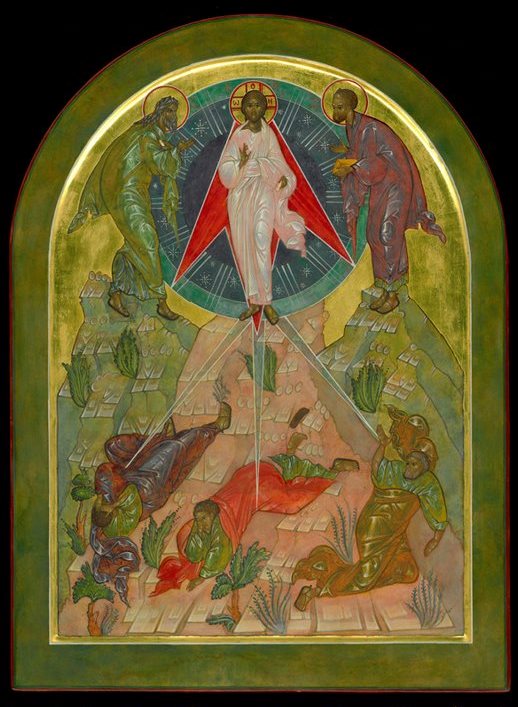
A modern icon of the Transfiguration by Alexander Ainetdinov … in Orthodox icons of the Transfiguration, we have drama and a moment full of movement

Luke 9: 28-36 (NRSVA):

28 Now about eight days after these sayings Jesus took with him Peter and John and James, and went up on the mountain to pray. 29 And while he was praying, the appearance of his face changed, and his clothes became dazzling white. 30 Suddenly they saw two men, Moses and Elijah, talking to him. 31 They appeared in glory and were speaking of his departure, which he was about to accomplish at Jerusalem. 32 Now Peter and his companions were weighed down with sleep; but since they had stayed awake, they saw his glory and the two men who stood with him. 33 Just as they were leaving him, Peter said to Jesus, ‘Master, it is good for us to be here; let us make three dwellings, one for you, one for Moses, and one for Elijah’—not knowing what he said. 34 While he was saying this, a cloud came and overshadowed them; and they were terrified as they entered the cloud. 35 Then from the cloud came a voice that said, ‘This is my Son, my Chosen; listen to him!’ 36 When the voice had spoken, Jesus was found alone. And they kept silent and in those days told no one any of the things they had seen.

The Transfiguration … an icon in the parish church in Piskopianó on the Greek island of Crete (Photograph: Patrick Comerford)

Liturgical Resources:

Liturgical colour: White.

Penitential Kyries:

Your unfailing kindness, O Lord, is in the heavens,
and your faithfulness reaches to the clouds.
Lord, have mercy.
Lord, have mercy.

Your righteousness in like the strong mountains,
and your justice as the great deep.
Christ, have mercy.
Christ, have mercy.

For with you is the well of life,
and in your light shall we see light.
Lord, have mercy.
Lord, have mercy.

Collect:

Father in heaven,
whose Son Jesus Christ was wonderfully transfigured
before chosen witnesses upon the holy mountain,
and spoke of the exodus he would accomplish at Jerusalem:
Give us strength so to hear his voice and bear our cross in this world,
that in the world to come we may see him as he is;
where he is alive and reigns with you and the Holy Spirit,
one God, now and for ever.

Introduction to the Peace:

Christ will transfigure your human body,
and give it a form like that of his own glorious body.
We are the Body of Christ. We share his peace.
(Philippians 3: 21, I Corinthians 11: 27; Romans 5: 1)

Preface:

Through Jesus Christ our Lord,
whose divine glory shone forth upon the holy mountain
before chosen witnesses of his majesty;
when your own voice from heaven
proclaimed him your beloved Son:

Post Communion Prayer:

Holy God,
we see your glory in the face of Jesus Christ.
May we who are partakers at his table
reflect his life in word and deed,
that all the world may know his power to change and save.
This we ask through Jesus Christ our Lord.

Blessing:

The God of all grace,
Who called you to his eternal glory in Christ Jesus,
establish, strengthen and settle you in the faith:

The Transfiguration depicted in Saint Mary Aldermary Church, Watling Street, London (Photograph: Patrick Comerford)

Suggested hymns:

Daniel 7: 9-10, 1314

6, Immortal, invisible, God only wise
125, Hail to the Lord’s anointed
468, How shall I sing that majesty
130, Jesus came, the heavens adoring
132, Lo! he comes; with clouds descending
34, O worship the King, all-glorious above
196, O worship the Lord in the beauty of holiness 678, Ten thousand times ten thousand
73, The day thou gavest, Lord, is ended
323, The God of Abraham praise

Psalm 97:

34, O worship the King all–glorious above
281, Rejoice, the Lord is King!
8, The Lord is King! Lift up your voice

II Peter 1: 16-19:

501, Christ is the world’s true light
52, Christ, whose glory fills the skies
613, Eternal light, shine in my heart
654, Light of the lonely pilgrim’s heart

Luke 9: 28-36:

325, Be still, for the presence of the Lord, the Holy One is he
643, Be thou my vision, O Lord of my heart
501, Christ is the world’s true light
205, Christ upon the mountain peak
52, Christ, whose glory fills the skies
331 God reveals his presence
209 Here in this holy time and place
101, Jesus, the very thought of thee
195, Lord, the light of your love is shining
102, Name of all majesty
60, O Jesus, Lord of heavenly race
449, Thee we adore, O hidden Saviour, thee
112, There is a Redeemer
374, When all thy mercies, O my God

The Transfiguration by Aidan Hart … in the Transfiguration, we see both the humanity and the divinity of Christ

Scripture quotations are from the New Revised Standard Version Bible: Anglicised Edition copyright © 1989, 1995, National Council of the Churches of Christ in the United States of America. Used by permission. All rights reserved worldwide. http://nrsvbibles.org

The hymn suggestions are provided in Sing to the Word (2000), edited by Bishop Edward Darling. The hymn numbers refer to the Church of Ireland’s Church Hymnal (5th edition, Oxford: OUP, 2000)

Material from the Book of Common Prayer is copyright © 2004, Representative Body of the Church of Ireland.

The Church of the Transfiguration in Sneem, Co Kerry (Photograph: Patrick Comerford)

Monday, 8 February 2021

Readings, hymns and
sermon ideas for
Sunday 14 February 2021,
Sunday before Lent,
Transfiguration Sunday

The Transfiguration depicted in a stained-glass window in the Collegiate Church of Saint Nicholas, Galway (Photograph: Patrick Comerford)

Patrick Comerford

Sunday next, 14 February 2021, is the Sunday before Lent, or Transfiguration Sunday. The options for the Sunday between 11 and 17 February (Proper 1) should not be used, as these apply only in years when this Sunday comes before the Second Sunday before Lent.

The readings in the Revised Common Lectionary (RCL) as adapted for use in the Church of Ireland for Sunday next are:

The Readings: II Kings 2: 1-12; Psalm 50: 1-6; II Corinthians 4: 3-6; and Mark 9: 2-9.

We should also remember that many people, especially young couples, are more likely to think of 14 February as Saint Valentine’s Day instead of the Sunday before Lent.
Witth this in mind, there are some additonal notes on Saint Valentine, and some appopriate liturgical resources and suggestions at the end of this posting.

The Transfiguration depicted in a stained-glass window in a church in Lucan, Co Dublin (Photograph: Patrick Comerford)

Celebrating the Transfiguration:

The two Sundays before Lent have special themes outside the cycle of readings in Ordinary Time. The Second Sunday before Lent focusses on Creation, while the Sunday before Lent is Transfiguration Sunday.

In early Church tradition, the Transfiguration is connected with the approaching death and resurrection of Christ, and so it was said to have taken place 40 days before the Crucifixion.

At first, the feast of the Transfiguration belonged to the pre-Easter season of the Church and was celebrated on one of the Sundays of Lent. For example, a sermon on the Transfiguration was preached in Lent by Saint John Chrysostom while he was a priest in Antioch in 390. The Feast of the Transfiguration was celebrated on Mount Sinai from the mid-fifth century, and in Constantinople from the late seventh century. Saint Gregory Palamas, the great teacher of the Transfiguration, is commemorated during Lent.

From 1474 until at least 1969, the Transfiguration was observed in the Roman Catholic Church on the Second Sunday in Lent. In some modern calendars, including Roman Catholic, Lutheran and Anglican calendars, the Transfiguration is now commemorated on the Sunday immediately before Ash Wednesday, although traditionally, the Feast of the Transfiguration is also observed in the Anglican, Roman Catholic and Orthodox calendars on 6 August. It may have been moved there because 6 August is 40 days before 14 September, the Feast of the Holy Cross, so keeping the tradition that the Transfiguration took place 40 days before the Crucifixion.

Among Anglicans, the Feast of the Transfiguration disappeared from the 1549 Book of Common Prayer. When it reappeared in the 1662 Book of Common Prayer, it returned to the calendar but without any other provisions.

In The Book of Common Prayer (2004), the Church of Ireland has Collects and Post-Communion prayers for the Feast of the Transfiguration on 6 August, along with this provision to mark the Transfiguration on the Sunday before Lent.

In the Orthodox Church, the Feast of the Transfiguration is a major feast, and is counted among the Twelve Great Feasts of the Church. This is also the second of the ‘Three Feasts of the Saviour in August.’ These are:

● The Procession of the Cross (1 August).
● The Transfiguration (6 August).
● The ‘Icon of Christ Not Made by Hands’ (16 August).

But the Transfiguration is also associated with ordinations: from the time of Pope Leo the Great (died 460), the Transfiguration was the Gospel reading set for Ember Saturday, the day before ordinations.

‘A chariot of fire and horses of fire separated the two of them, and Elijah ascended in a whirlwind into heaven’ (II Kings 2: 11) … Elijah in the Chariot of Fire, depicted in a window in Church of Saint Mary the Virgin, Newport, Essex (Photograph: Patrick Comerford)

II Kings 2: 1-12:

The first reading is the story of Elijah ascending in the chariot of fire in a whirlwind into heaven.

Israel has split into two kingdoms: Israel in the north and Judah in the south. At the time of this reading (850-849 BC), Ahaziah is King of Israel. The Bible describes only two people as worthy enough to be taken up to heaven without dying: Enoch (Genesis 5: 24) and Elijah.

Elijah and Elisha start their journey at Gilgal, in the hill country north of Bethel. On three occasions, Elijah invites Elisha to travel no further, and he tests Elisha, to see whether he is truly loyal. Elisha proves his loyalty each time, and so the two travel south from Gilgal to Bethel, then east to Jericho and the Jordan.

The ‘company of prophets’ are communities of followers, disciples, of Elijah. They are like monks, and traditions about them have become part of the story of the Carmelite order.

Elijah’s mantle or cloak is almost part of him. When the waters part, readers would recall the crossing of the Red Sea (Exodus 14) and the Ark being carried across the Jordan (Joshua 3: 14-17).

Elijah offers Elisha a reward for his loyalty. Elisha asks that he receive a double share or the principal part of Elijah’s spirituality. Custom and law said the eldest son should inherit a double portion of his father’s possessions (see Deuteronomy 21: 17). Elijah cannot grant this request himself, for it is God’s to give. If Elisha sees Elijah taken up, God will grant the wish. Fire is a symbol of God’s presence, and recalls how God appeared in the burning bush (see Exodus 3: 2).

What is happening in verse 12? Perhaps Elisha is comparing the chariots of God with the chariots of Israel; perhaps he recognises that Elijah’s spiritual strength is better security for Israel than its army. Elisha sees Elijah’s departure. Tearing clothes is still a Jewish tradition in expressing grief.

In the verses that follow, Elisha picks up Elijah’s mantle, the symbol of spirituality. Elijah has been taken up to heaven, and Elisha is his successor.

‘Let the heavens declare his righteousness’ (Psalm 50: 6) … the skies seen from inside the bell tower beside Saint Mary’s Church, Askeaton, Co Limerick (Photograph: Patrick Comerford, 2021)

Psalm 50: 1-6:

Psalm talks 50 is about God who shines forth and who being revealed in glory. This psalm is a liturgy of divine judgment.

God calls summons the whole earth and the heaven above to witness his legal judgment of the ungodly. In Zion, or Jerusalem, he shows himself in traditional Biblical ways: in fire and tempest (verse 3). This is the God of heaven and earth (verse 4).

He is both judge (verse 6) and prosecutor (‘testify,’ verse 7), and the heavens declare his righteousness (verse 6).

‘We have this treasure in clay jars’ (II Corinthians 4: 7) … clay jars on a street in Rethymnon in Crete (Photograph: Patrick Comerford)

II Corinthians 4: 5-12:

In this Epistle reading, the Apostle Paul writes about the minds of unbelievers being blinded, while our eyes should be focussed on the light of the Gospel, which is the glory of Christ, who is the image of God, and of light shining out of darkness.

Saint Paul is continuing to answer a letter from the Church in Corinth. It seems some Church members there have criticised him for failing to make clear the good news, or for limited success in bringing people to Christ.

Now, in this reading, Saint Paul defends himself, saying that, despite what some may say, he proclaims not himself but Jesus Christ as Lord (verse 5).

He quotes the first words God speaks in the Bible, ‘Let light shine out of darkness’ (verse 6, see Genesis 1: 3). He points out that God begins the process of creation with light, and this light is ‘the knowledge of the glory of God in the face of Jesus Christ.’

Despite our sufferings in this world, the life of Jesus is made visible in the way we live (verse 11).

The Transfiguration by Aidan Hart … in the Transfiguration, both the humanity and divinity of Christ are manifested to us

The Transfiguration

The Transfiguration is described in the three Synoptic Gospels (see Matthew 17: 1-9; Mark 9: 2-8; Luke 9: 28-36). In addition, there may be allusions to the Transfiguration in John 1: 14 and in II Peter 1: 1-18, where Peter describes himself as an eyewitness ‘of his sovereign majesty.’

The Synoptic accounts of the Transfiguration are very similar in wording.

So, what is different between Saint Mark’s account of the Transfiguration and the accounts in the other two Synoptic Gospels?

Saint Mark, like Saint Matthew, tells us these events take place ‘six days later,’ although Saint Luke says they take place ‘eight days later.’

All three accounts tell us that Christ’s robes become dazzling white, but Saint Mark alone tells us they are a white ‘such as no one on earth could bleach them’ (verse 3).

Saint Mark also tells us the three disciples were ‘terrified.’

A modern icon of the Transfiguration … the Transfiguration also points to Christ’s great and glorious Second Coming and the fulfilment of the Kingdom of God

Telling the story

Should we describe the Transfiguration as a miracle? If we do, then it is the only Gospel miracle that happens to Christ himself. On the other hand, Saint Thomas Aquinas spoke of the Transfiguration as ‘the greatest miracle,’ because it complemented Baptism and showed the perfection of life in Heaven.

Saint Peter’s reference to the booths could imply that the Transfiguration took place during the time of the Feast of Tabernacles, when Biblical Jews were camping out in the fields for the grape harvest. This Feast also recalled the wanderings in the wilderness recorded in the Book Exodus.

None of the Gospel accounts identifies the ‘high mountain’ by name. The earliest identification of the mountain as Mount Tabor was by Jerome in the late fourth century. But does it matter where the location is?

Consider the place of Mountains in the salvation story and in revelation:

● Moses meets God in the cloud and the burning bush on Mount Sinai, and there receives the tablets of the Covenant (Exodus 25 to 31);
● Elijah confronts the prophets of Baal on Mount Carmel (I Kings 18);
● Elijah climbs Mount Sinai and finds God not in the wind, the earthquake or the fire, but in the still small voice in the cleft of the Mountain (I Kings 19: 12);
● The Sermon, which is the ‘manifesto’ of the new covenant, is the Sermon on the Mount;
● The Mount of Olives is a key location in the Passion narrative;
● Christ is crucified on Mount Calvary;
● Saint John receives his Revelation in the cave at the top of the mountain on Patmos.

As for the cloud, all three Synoptic Gospels describe the cloud’s descent in terms of overshadowing (επισκιαζειν, episkiazein), which in Greek is a pun on the word tent (σκηνάς, skenas). But this is also the same word used to describe the Holy Spirit overshadowing the Virgin Mary at the Annunciation: καὶ δύναμις ὑψίστου ἐπισκιάσει σοι (Luke 1: 35).

We may recall how the pillar of cloud leads the people through the wilderness by day, just as the pillar of fire leads them by night. Moses entered the cloud on Mount Sinai (Exodus 24: 18), the Shekinah cloud is the localised manifestation of the presence of God (Exodus 19: 9; 33: 9; 34: 5; 40: 34; II Maccabees 2: 8).

The cloud takes Christ up into heaven at the Ascension (Acts 1: 9-10).

Saint Paul talks about the living and the dead being caught up in the cloud to meet the Lord (I Thessalonians 4: 17).

The Transfiguration … a fresco in an Orthodox church in the US

The principle characters:

Christ is the focus of the Transfiguration, but who are the other principle characters in this story?

1, The Trinity: in Orthodox theology, the Transfiguration is not only a feast in honour of Christ, but a feast of the Holy Trinity, for all three Persons of the Trinity are present at that moment:

● God the Father speaks from heaven: ‘This is my Son, the Beloved; with him I am well pleased; listen to him’ (Matthew 17: 5).
● God the Son is transfigured.
● God the Holy Spirit is present in the form of a cloud.

In this sense, the Transfiguration is also considered the ‘Small Epiphany’ – the ‘Great Epiphany’ being the Baptism of Christ, when the Holy Trinity appears in a similar pattern).

2, Moses and Elijah: At the Transfiguration, Christ appears with Moses and Elijah, the two pre-eminent figures of Judaism, standing alongside him. Saint John Chrysostom explains their presence in three ways:

● They represent the Law and the Prophets – Moses receives the Law from God, and Elijah is a great prophet.
● They both experience visions of God – Moses on Mount Sinai and Elijah on Mount Carmel.
● They represent the living and the dead – Elijah, the living, because he is taken up into heaven in a chariot of fire (see the first reading for this day), and Moses, the dead, because he does experience death.

Moses and Elijah show that the Law and the Prophets point to the coming of Christ, and their recognition of and conversation with Christ symbolise how he fulfils ‘the law and the prophets’ (Matthew 5: 17-19). Moses and Elijah also stand for the living and dead, for Moses dies and his burial place is known, while Elijah is taken alive into heaven in order to appear again to announce the time of God’s salvation.

It was commonly believed that Elijah would reappear before the coming of the Messiah (see Malachi 4), and the three interpret Christ’s response as a reference to Saint John the Baptist (Matthew 17: 13).

3, The Disciples: Saint Peter, Saint James and Saint John are with Christ on the mountain top. But, we may ask, why these three disciples?

Do you remember how this might relate to Moses and Elijah? Moses ascends the mountain with three trusted companions, Aaron, Nadab and Abihu, to confirm the covenant (Exodus 24: 1), and God’s glory covers the mountain in a cloud for six days (Exodus 25 to 31).

In some ways, Saint Peter, Saint James and Saint John serve as an inner circle or a ‘kitchen cabinet’ in the Gospels. Perhaps this intimacy is reflected in the fact that they are the only disciples who are given nickname by Christ: Simon becomes the Rock, and James and John are the sons of thunder (Luke 5: 10).

They are at the Transfiguration (Matthew 17: 1, Mark 9: 2; Luke 9: 28), but they are also at the raising of the daughter of Jairus (Mark 5: 35-43; Luke 6: 51), they are at the top of the Mount of Olives when Christ is about to enter Jerusalem (Mark 13: 3), they help to prepare for the Passover (Luke 22: 8), and they are in Gethsemane (Matthew 26: 37).

Jerome speaks of Saint Peter as the rock on which the Church is built, Saint James as the first of the apostles to die a martyr’s death, Saint John as the beloved disciple.

They are a trusted group who also serve to represent us at each moment in the story of salvation.

The Church of the Transfiguration in Sneem, Co Kerry (Photograph: Patrick Comerford, 2020)

The meaning of the Transfiguration:

The Transfiguration of Christ in itself is the fulfilment of all of the Theophanies and manifestations of God, a fulfilment made perfect and complete in the person of Christ. We could say the Transfiguration is the culmination of Christ’s public life, just as his Baptism is its starting point, and his Ascension its end. As Archbishop Michael Ramsey writes in his book, The Glory of God and the Transfiguration of Christ: ‘The Transfiguration stands as a gateway to the saving events of the Gospel.’

The Transfiguration reveals Christ’s identity as the Son of God. In the Gospel, after the voice speaks, Elijah and Moses have disappeared, and Christ and the three head down the mountain. The three ask themselves what he means by ‘risen from the dead’ (Mark 9: 9-10). When they ask Christ about Elijah, he responds: ‘Elijah is indeed coming and will restore all things; but I tell you that Elijah has already come …’ (Mark 9: 12-13). He tells them to keep these things a secret until the Son of Man has risen from the dead. Yet, in keeping with the Messianic secret, he tells the three not to tell others what they have seen until he has risen on the third day after his death.

Event and process

The Transfiguration is both an event and a process. The original Greek word for Transfiguration in the Gospel accounts is μεταμόρφωσις (metamorphosis), which gives us access to a deeper and more theological meaning, a deeper truth, than the word derived from the Latin transfiguratio, which can be translated by ‘to be changed into another from.’ But the Greek μεταμόρφωσις means ‘to progress from one state of being to another.’ Consider the metamorphosis of the chrysalis into the butterfly.

Saint Paul also uses the word μεταμόρφωσις when he describes how the Christian is to be transfigured, transformed, into the image of Christ (II Corinthians 3: 18).

The metamorphosis invites us into the event of becoming what we have been created to be. This is what Orthodox writers call deification. Transfiguration is a profound change, by God, in Christ, through the Spirit. And so, the Transfiguration reveals to us our ultimate destiny as Christians, the ultimate destiny of all people and all creation to be transformed and glorified by the majestic splendour of God himself.

The Transfiguration points to Christ’s great and glorious Second Coming and the fulfilment of the Kingdom of God, when all of creation will be transfigured and filled with light. The vision of Christ in his glory and the experience of the divine light are at the very heart of both Orthodox mysticism and Orthodox eschatology. The ‘uncreated light’ is a hallmark theme in Orthodox spirituality, especially in the writings of Saint Gregory Palamas and the school of the thought that is hesychasm, which draws constantly on the themes of the Transfiguration.

Saint Gregory Palamas distinguishes between the essence of God, which is beyond human apprehension, and the energies of God, which are the ways in which we can experience and know God. According to him, the light of the Transfiguration ‘is not something that comes to be and then vanishes.’ Rather, Christ’s disciples experienced a transformation of their senses so that ‘they beheld the Ineffable Light where and to the extent that the Spirit granted it to them.’

This was, therefore, not only a prefiguration of the eternal blessedness to which all Christians look forward, but also of the Kingdom of God already revealed, realised and come.

In Orthodox theology, since Patristic times, the three booths or tents that the three disciples want to erect represent three stages of salvation:

● Virtue, which is the active life of ascetic struggle, and which is represented by Elijah.
● Spiritual knowledge, which requires right discernment in natural contemplation or contemplation of the natural order, which was disclosed by Moses.
● Theology, which means contemplation of God, which requires the consummate perfection of wisdom, and which was revealed by Christ.

The Transfiguration in a poster from the Institute for Orthodox Christian Studies, Cambridge

Concluding images:

In a lecture in Cambridge ten years ago [2011], Metropolitan Kallistos [Ware], the pre-eminent Orthodox theologian in England, spoke of the Transfiguration as a disclosure not only of what God is but of what we are. The New Adam shows us human nature as it was before the fall. The Transfiguration looks back to the beginning, but also looks forward to the end, to the final glory of Christ’s second coming, because through the incarnation Christ raised human nature to a new level, opening new possibilities.

The incarnation is a new beginning for the human race, and in the Transfiguration we see not only our human nature at the beginning, but as it can be in and through Christ at the end, he told the Summer School in Sidney Sussex College organised by the Institute for Orthodox Christian Studies.

Secular Christianity rests satisfied with our human nature as it is now. But he wants us to look to our potentialities, as seen in the Transfiguration of Christ. The light of the Transfiguration embraces all created things, nothing is irredeemably secular, all created things can be bathed in the light of the Transfiguration.

He also referred to Revelation 21: 5, where Christ tells the Seer of Patmos: ‘Behold, I make all things new’ – not: ‘Behold, I make all new things.’ The Transfiguration is a pre-figuration of the transfiguration of the cosmos, he said.

But with the Transfiguration comes the invitation to bear the cross with Christ. Peter, James and John were with Christ on Mount Tabor and with him in Gethsemane. We must understand the Passion of Christ and the Transfiguration in the light of each other, not as two separate mysteries, but aspects of the one single mystery. Mount Tabor and Mount Calvary go together; and glory and suffering go together.

If we are to undertake the task of Transfiguration, we cannot leave our cross behind. If we are to bring the secular, fallen world into the glory of Christ, that has to be through self-emptying κένωσις (kenosis), cross-bearing and suffering. There is no answer to secularism that does not take account of the Cross, as well taking account of the Transfiguration and the Resurrection.

The Transfiguration provides a guideline for confronting the secular world, he said. And he retold a story from Leo Tolstoy, Three Questions. The central figure is set a task of answering three questions:

What is the most important moment? The most important moment is now, the past is gone, and the future does not exist yet.

Who is the most important person? This person who is before you in this very instant.

What is the most important task? This task which you are engaged in here and now.

The light which shone from Christ on the mountaintop is not a physical and created light, but an eternal and uncreated light, a divine light, the light of the Godhead, the light of the Holy Trinity.

The experience on Mount Tabor confirms Saint Peter’s confession of faith which reveals Christ as the Son of the Living God. Yet Christ remains fully human as ever he was, as fully human as you or I, and his humanity is not abolished. But the Godhead shines through his body and from it.

In Christ dwells all the fullness of the Godhead. But at other points in his life, the glory is hidden beneath the veil of his flesh. What we see in Christ on Mount Tabor is human nature, our human nature, taken up into God and filled with the light of God. ‘So this should be our attitude to the secular world,’ Metropolitan Kallistos said.

Or, as the Revd Dr Kenneth Leech once said: ‘Transfiguration can and does occur “just around the corner,” occurs in the midst of perplexity, imperfection, and disastrous misunderstanding.’

The Transfiguration in an icon in the parish church in the hill-side village of Piskopiano in Crete (Photograph: Patrick Comerford)

Some questions to consider

Is this a more appropriate time for celebrating the Transfiguration?

Can you identify with Saint Peter’s hasty response?

Or do you sometimes feel terrified in the presence of God, and know not what to do?

Saint Matthew alone has Christ telling the three disciples: ‘Get up and do not be afraid.’ (Matthew 17: 7). What are people’s fears today? What role have we in calming those fears and in reassuring people of the presence of Christ?

Where do you think people can be brought to see Christ today? In the Church? In the poor? In themselves?

Look at verse 9. Is there an appropriate time for mission and an inappropriate time?

The Transfiguration, an icon by Adrienne Lord in Christ Church Cathedral, Dublin (Photograph: Patrick Comerford)

Mark 9: 2-9 (NRSVA):

2 Six days later, Jesus took with him Peter and James and John, and led them up a high mountain apart, by themselves. And he was transfigured before them, 3 and his clothes became dazzling white, such as no one on earth could bleach them. 4 And there appeared to them Elijah with Moses, who were talking with Jesus. 5 Then Peter said to Jesus, ‘Rabbi, it is good for us to be here; let us make three dwellings, one for you, one for Moses, and one for Elijah.’ 6 He did not know what to say, for they were terrified. 7 Then a cloud overshadowed them, and from the cloud there came a voice, ‘This is my Son, the Beloved; listen to him!’ 8 Suddenly when they looked around, they saw no one with them any more, but only Jesus.

9 As they were coming down the mountain, he ordered them to tell no one about what they had seen, until after the Son of Man had risen from the dead.

The Transfiguration depicted in a fresco in the Analipsi Church (Resurrection) in Georgioupoli, Crete (Photograph: Patrick Comerford)

Liturgical Resources:

Liturgical Colour: White (Transfiguration) or Green (the Sunday before Lent).

Note the liturgical colour returns to Green for Monday and Tuesday, and then turns to Violent on Wednesday 17 February 2021 (Ash Wednesday).

Penitential Kyries:

Your unfailing kindness, O Lord, is in the heavens,
and your faithfulness reaches to the clouds.
Lord, have mercy.
Lord, have mercy.

Your righteousness is like the strong mountains,
and your justice as the great deep.
Christ, have mercy.
Christ, have mercy.

For with you is the well of life:
and in your light shall we see light.
Lord, have mercy.
Lord, have mercy.

The Collect of the Day:

Almighty Father,
whose Son was revealed in majesty
before he suffered death upon the cross:
Give us grace to perceive his glory,
that we may be strengthened to suffer with him
and be changed into his likeness, from glory to glory;
who is alive and reigns with you and the Holy Spirit,
one God, now and for ever.

The Collect of the Word:

Holy God,
you have revealed the glory of your love in Jesus Christ,
and have given us a share in your Spirit.
May we who listen to Christ
follow faithfully,
and, in the dark places where you send us,
reveal the light of your gospel.

Introduction to the Peace:

Christ will transfigure our human body
and give it a form like that of his own glorious body.
We are the Body of Christ. We share his peace.
(cf Philippians 3: 21, 1 Corinthians 11: 27, Romans 5: 1)

Preface:

Through Jesus Christ our Lord,
whose divine glory shone forth upon the holy mountain
before chosen witnesses of his majesty;
when your own voice from heaven
proclaimed him your beloved Son:

Post Communion Prayer:

Holy God
we see your glory in the face of Jesus Christ.
May we who are partakers at his table
reflect his life in word and deed,
that all the world may know
his power to change and save.
This we ask through Jesus Christ our Lord.

Blessing:

The God of all grace,
who called you to his eternal glory in Christ Jesus,
establish, strengthen and settle you in the faith:

The Transfiguration depicted in a fresco in the Church of the Four Martyrs in Rethymnon, Crete … in Orthodox icons of the Transfiguration, we have drama and a moment full of movement (Photograph: Patrick Comerford)

Suggested Hymns:

II Kings 2: 1-12:

643, Be thou my vision, O Lord of my heart
297, Come, thou Holy Spirit, come
298, Filled with the Spirit’s power, with one accord
647, Guide me, O thou great Jehovah
386, Spirit of God, unseen as the wind
310, Spirit of the living God

Psalm 50: 1-6:

501, Christ is the world’s true light
381, God has spoken – by his prophets
97, Jesus shall reign where’er the sun
362, O God, beyond all praising

II Corinthians 4: 3-6:

684, All praise to thee, for thou, O King divine
11, Can we by searching find our God
52, Christ, whose glory fills the skies
613, Eternal light shine in my heart
481, God is working his purpose out as year succeeds to year
324, God, whose almighty word
6, Immortal, invisible, God only wise
482, Jesus bids us shine with a pure clear light
484, Lift high the cross, the love of Christ proclaim
195, Lord, the light of your love is shining
228, Meekness and majesty
486, People of God, arise
341, Spirit divine, attend our prayers
490, The Spirit lives to set us free
491, We have a gospel to proclaim
493, Ye that know the Lord is gracious

Mark 9: 2-9:

325, Be still, for the presence of the Lord, the Holy One is here
643, Be thou my vision, O Lord of my heart
501, Christ is the world’s true light
205, Christ upon the mountain peak
52, Christ, whose glory fills the skies
331, God reveals his presence
209, Here in this holy time and place
101, Jesus, the very thought of thee
195, Lord, the light of your love is shining
102, Name of all majesty
60, O Jesus, Lord of heavenly race
449, Thee we adore, O hidden Saviour, thee
112, There is a Redeemer
374, When all thy mercies, O my God

Hearts and gifts for Saint Valentine’s Day in a shopfront in Askeaton, Co Limerick (Photograph: Patrick Comerford)

An additional note on Saint Valentine’s Day:

For many people, especially young couples, they are more likely to think of 14 February as Saint Valentine’s Day instead of the Sunday before Lent.

Thousands of locks will be secured to bridges and fences across Europe, Juliet’s supposed balcony in Verona will be visited by countless tourists and the Carmelite Church in Whitefriar Street, Dublin, will be full for special masses marking Saint Valentine’s Day, when the martyr’s reliquary is taken from a special shrine in a side chapel and placed before the High Altar.

Saint Valentine is a widely believed to have been a third century Roman martyr. He is commemorated on 14 February and since the High Middle Ages he has been associated with young love.

Yet, despite his popularity, we know nothing reliable about Saint Valentine apart from his name and the tradition that he died a martyr’s death on 14 February on the Via Flaminia, north of Rome. Many of the stories about his life are mythical and unreliable.

Popular legend says Valentine was a Roman priest who was martyred during the reign of Claudius II, Claudius Gothicus. He was arrested and imprisoned when he was caught marrying Christian couples and helping persecuted Christians.

It is said Claudius took a liking to this prisoner. But when Valentinus tried to convert the Emperor, he was condemned to death. He was beaten with clubs and stones; when that failed to kill him, he was beheaded outside the Flaminian Gate.

Many of the legends about Saint Valentine can be traced only to 14th century England and the writings of Geoffrey Chaucer and his circle, when 14 February was already linked with romantic love.

Because of the myths and legends, Saint Valentine was dropped from the Roman Catholic Calendar of Saints in 1969. Nevertheless, the ‘Martyr Valentinus who died on 14 February on the Via Flaminia close to the Milvian Bridge in Rome’ is still on the list of officially recognised saints.

The day is alsocelebrated as Saint Valentine’s Day with a commemoration in Common Worship in the Church of England and in other churches in the Anglican Communion.

The relics of Saint Valentine were given by Pope Gregory XVI as a gift to Father John Spratt, an Irish Carmelite Prior, after he preached a popular sermon in the Jesuit church in Rome, the Gesu, in 1836. Since then, they have been kept in a shrine in the Carmelite Church in Whitefriar Street, Dublin.

Although the story of Saint Valentine is inextricably linked with romantic young love, it is good to be reminded of love as we prepare for Lent, and that our Lenten pilgrimage is a journey towards fully accepting the love of God offered to us through Christ on Good Friday and Easter Day.

Liturgical resources:

These prayers, included in suggested intercessions in the Book of Common Prayer for Wednesdays, may be helpful in writing prayers on the theme of love:

Loving Father, we give you thanks
for the obedience of Christ fulfilled in the cross,
his bearing of the sin of the world,
his mercy for the world which never fails …

for the joy of loving and being loved,
for friendship,
the lives to which our own are bound,
the gift of peace with you and one another …

for the communities in whose life we share
and all relationships in which reconciliation may be known …

These collects may also be used as additional collects after the Collect of the Day:

The Collect (Trinity II):

Lord, you have taught us
that all our doings without love are nothing worth:
Send your Holy Spirit
and pour into our hearts that most excellent gift of love,
the true bond of peace and of all virtues,
without which whoever lives is counted dead before you.
Grant this for your only Son Jesus Christ’s sake.
(Book of Common Prayer, p 141).

The Collect (Trinity VI):

Merciful God,
you have prepared for those who love you
such good things as pass our understanding:
Pour into our hearts such love toward you
that we, loving you above all things,
may obtain your promises,
which exceed all that we can desire;
through Jesus Christ our Lord.

Concluding Prayer:

Help us to share in Christ’s ministry
of love and service to one another;
through the same Jesus Christ our Lord,
who in the unity of the Holy Spirit
is one with you for ever. Amen.
(Book of Common Prayer, p 141).

The shrine of Saint Valentine in the Carmelite Church in Whitefriar Street, Dublin (Photograph: Patrick Comerford)

Scripture quotations are from the New Revised Standard Version Bible: Anglicised Edition copyright © 1989, 1995, National Council of the Churches of Christ in the United States of America. Used by permission. All rights reserved worldwide. http://nrsvbibles.org

Material from the Book of Common Prayer is copyright © 2004, Representative Body of the Church of Ireland.

The hymn suggestions are provided in Sing to the Word (2000), edited by Bishop Edward Darling. The hymn numbers refer to the Church of Ireland’s Church Hymnal (5th edition, Oxford: OUP, 2000).

The Monastery of the Transfiguration or Great Meteoron in Meteora, northern Greece (Photograph: Patrick Comerford, 2019)

Monday, 17 February 2020

Readings, hymns and
sermon ideas for
Sunday 23 February 2020,
the Sunday before Lent

The Transfiguration depicted in a stained-glass window in a church in Lucan, Co Dublin (Photograph: Patrick Comerford, 2018)

Patrick Comerford


Next Sunday, 23 February 2020, is the Sunday before Lent.

The readings in the Revised Common Lectionary, as adapted for use in the Church of Ireland, offer two choices:

The Readings, Option A (The Transfiguration): Exodus 24: 12-18; Psalm 2 or Psalm 99; II Peter 1: 16-21; Matthew 17: 1-9.

There is a link to the readings HERE.

The Readings, Option B (Proper 4): Genesis 6: 9-22, 7: 24, 8: 14-19; Psalm 46; Romans 1: 16-17, 3: 22b-28 [29-31]; Matthew 7:21-29.

There is a link to the readings HERE.

The Transfiguration depicted in a stained-glass window in the Collegiate Church of Saint Nicholas, Galway (Photograph: Patrick Comerford, 2019)

Part 1, Option A (The Transfiguration):

Introducing the readings:

The Feast of the Transfiguration is traditionally celebrated on 6 August. So, you may wonder, why is it also marked in the Book of Common Prayer, the Church Calendar and the Lectionary as the first and preferred option for the Sunday before Lent?

In early Church tradition, the Transfiguration is connected with the approaching death and resurrection of Christ, and so was said to have taken place 40 days before the Crucifixion.

There is historical evidence that the feast of the Transfiguration belonged first to the pre-Easter season of the Church and that the Transfiguration was then celebrated on one of the Sundays of Lent. A sermon on the Transfiguration was preached in Lent by John Chrysostom while he was a priest in Antioch in 390. Saint Gregory Palamas, the great teacher of the Transfiguration, is commemorated during Lent.

We know from iconographic evidence that the Feast of the Transfiguration was celebrated on Mount Sinai from the mid-fifth century, and the feast may have reached Constantinople in the late seventh century.

From 1474 until at least 1969, it was observed in the Roman Catholic Church on the Second Sunday in Lent. In some modern calendars, including Roman Catholic, Lutheran and Anglican calendars, the Transfiguration is now commemorated on the Sunday before Lent.

However, traditionally, the Feast of the Transfiguration is observed in the Anglican, Roman Catholic and Orthodox calendars on 6 August. It may have been moved there because 6 August is 40 days before 14 September, the Feast of the Holy Cross, so keeping the tradition that the Transfiguration took place 40 days before the Crucifixion.

This celebration disappeared from the 1549 Book of Common Prayer, and when it reappeared in the 1662 Book of Common Prayer it was only named in the calendar without any other provisions.

In the Book of Common Prayer 2004, the Church of Ireland provided Collects and Post-Communion prayers for the Feast of the Transfiguration on 6 August, and there is an alternative provision to mark the Transfiguration on the Sunday before Lent.

The Transfiguration has immense Christological importance, for both the humanity and divinity of Christ are manifested to the disciples, and so to us. This was developed as a theological thought in a sermon on the Transfiguration once said to have been written by Saint Ephrem the Syrian (ca 306-373), but now thought to have been written by a latter writer. Nevertheless, celebrating the Transfiguration at that time helped to underpin the teachings on the divine and human natures of Christ, encapsulated in the Creeds of Nicaea, Constantinople and Chalcedon.

The Transfiguration also points to Christ’s great and glorious Second Coming and the fulfilment of the Kingdom of God, when all of creation will be transfigured and filled with light. The vision of Christ in his glory and the experience of the divine light are at the very heart of both Orthodox mysticism and Orthodox eschatology. The ‘uncreated light’ is a hallmark theme in Orthodox spirituality, especially in the writings of Saint Gregory Palamas and the school of the thought that is hesychasm, which draws constantly on the themes of the Transfiguration.

Saint Gregory Palamas distinguishes between the essence of God, which is beyond human apprehension, and the energies of God, which are the ways in which we can experience and know God. According to him, the light of the Transfiguration ‘is not something that comes to be and then vanishes.’ Rather, Christ’s disciples experienced a transformation of their senses so that ‘they beheld the Ineffable Light where and to the extent that the Spirit granted it to them.’

This was, therefore, not only a prefiguration of the eternal blessedness to which all Christians look forward, but also of the Kingdom of God already revealed, realised and come.

The Transfiguration is both an event and a process. The original Greek word in the Gospel accounts for Transfiguration is metamorphosis (μεταμόρφωσις), and gives us access to deeper and more theological meaning, a deeper truth, than the word derived from the Latin transfiguratio, which can be translated by ‘to be changed into another from.’ But the Greek metamorphosis (μεταμόρφωσις) means ‘to progress from one state of being to another.’ Consider the metamorphosis of the chrysalis into the butterfly. The metamorphosis invites us into the event of becoming what we have been created to be. This is what orthodox writers call deification.

Or, as the Revd Dr Kenneth Leech once said: ‘Transfiguration can and does occur ‘just around the corner,’ occurs in the midst of perplexity, imperfection, and disastrous misunderstanding.’

‘Aleph Male’ a ceramic glazed tile (20x30x1.5 cm) by Joel Itman, depicting Moses with the Ten Commandments and illustrating a Jewish Art Calendar published in Italy (Photograph: Patrick Comerford, 2019)

Exodus 24: 12-18:

Moses has ascended Mount Sinai to receive the Law. Now God offers to put all the laws in permanent form, on tablets of stone. So important is Moses’ ascent of the mountain that it is mentioned four times in this reading. Moses leaves the elders in charge and commissions Aaron and Hur to administer justice in his absence.

God’s glory is an envelope of light, a bright cloud, veiling his being. The people can see the cloud, but not God. Unlike the light from the Burning Bush (Exodus 3), this appearance of God is frightening, ‘like a devouring fire.’ Moses prepares to meet God for ‘six days’ (verse 16), the time of creation in last week’s creation reading. The 40 days and 40 nights in verse 18 recall the days of the Flood, the time the Israelites scouted out Canaan’s defences before entering the Promised Land, Elijah’s later experience on the same mountain.

This reading prepares us for the Gospel account of the Transfiguration, but also prepares us for the 40 days of Lent.

‘Moses and Aaron were among his priests’ (Psalm 99: 6) … Moses and Aaron depicted in a stained-glass window in Drumcliffe Church, Ennis, Co Clare (Photograph: Patrick Comerford, 2018)

Psalm 2:

Psalm 2 was probably written for the coronation of a king of Judah. The word anointed is messiah in the Hebrew. It was used as the title of an Israelite king, but after the end of the monarchy it became the title or name of the ideal future king who would restore Israel to glory. New Testament writers apply this title to Christ.

Subject kings are plotting a rebellion against the new king instead of accepting him as the Lord’s anointed representative, so their rebellious plots are like a revolt against God himself. God responds (verse 4-6), saying he has chosen ‘my king’ and established him in his dwelling place on earth at Zion or Jerusalem.

The new king then then speaks (verses 7-12), accepting his adoption as God’s son, and warns other kings to submit.

Or:

Psalm 99:

Psalm 99 is a hymn of praise to God as king, and a call to worship him ‘on his holy mountain.’ God is on his throne above the cherubim in the Temple, and is to be worshipped by all the peoples. God has helped people in need, promoted justice, has given them just laws, heard their prayers, and punished and forgiven them.

When the people cried out to God, he spoke to them in the pillar of cloud.

The threefold endings of verses 3, 5 and 9 – ‘Holy is he!’ … ‘Holy is he!’ … ‘for the Lord our God is holy’ – may be a refrain by worshippers as they extol and worship God (verse 9).

The Transfiguration in an icon in the parish church in the hill-side village of Piskopiano in Crete (Photograph: Patrick Comerford, 2017)

II Peter 1: 16-21:

In this reading, the writer speaks of the Transfiguration. While other, false teachers have used cleverly devised myths to deceive members of the community (see II Peter 2: 1-3), the author recalls that he was an eyewitness (verse 16) to the Transfiguration, in which the power of God was shown, and which was a also a preview of Christ’s second coming.

At the Transfiguration, at time, Christ received honour and glory from God the Father, when the heavenly voice identified him as ‘my Son, my Beloved …’ (verse 17). The Prophets foretold the coming of the Messiah, and the Transfiguration confirms this (verse 19). We are called to be consistent in holding to this hope despite false teachers until the Second Coming.

The Transfiguration, an icon by Adrienne Lord in Christ Church Cathedral, Dublin (Photograph: Patrick Comerford, 2019)

Matthew 17: 1-9:

Introduction: The Biblical story

This is one of the three descriptions of the Transfiguration in the Synoptic Gospels (see Matthew 17: 1-9; Mark 9: 2-8; Luke 9: 28-36). In addition, there may be allusions to the Transfiguration in John 1: 14 and in II Peter 1: 1-18, where Peter says he has been an eyewitness ‘of his sovereign majesty.’

Of course, there is an obvious question: Why is there no Transfiguration narrative in Saint John’s Gospel? But then, there is no Eucharistic institution narrative in the Fourth Gospel either. Perhaps we could say that the Fourth Gospel is shot through with the Transfiguration and the light of the Transfiguration, from beginning to end, just as it is shot through with Eucharistic narratives from beginning to end.

But should we describe the Transfiguration as a miracle? If we do, then it is the only Gospel miracle that happens to Christ himself. On the other hand, Thomas Aquinas spoke of the Transfiguration as ‘the greatest miracle,’ because it complemented baptism and showed the perfection of life in Heaven.

None of the accounts identifies the ‘high mountain’ by name. The earliest identification of the mountain as Mount Tabor was by Jerome in the late fourth century.

But does it matter where the location is? Consider the place of Mountains in the salvation story and in revelation:

● Moses meets God in the cloud and the burning bush on Mount Sinai, and there receives the tablets of the Covenant (Exodus 25 to 31);
● Elijah confronts the prophets of Baal on Mount Carmel (I Kings 18);
● Elijah climbs Mount Sinai and finds God not in the wind, the earthquake or the fire, but in the still small voice in the cleft of the Mountain (I Kings 19: 12);
● The Sermon, which is the “manifesto” of the new covenant, is the Sermon on the Mount, which we have been reading for the past few weeks;
● The Mount of Olives is a key location in the Passion narrative;
● Christ is crucified on Mount Calvary;
● John receives his Revelation in the cave at the top of the mountain on Patmos.

As for the cloud, as three Synoptic Gospels describe the cloud’s descent in terms of overshadowing (episkiazein), which in the Greek is a pun on the word tent (skenas), but is also the same word used to describe the Holy Spirit overshadowing the Virgin Mary at the Annunciation (Luke 1: 35).

In the Old Testament, the pillar of cloud leads the people through the wilderness by day, just as the pillar of fire leads them by night. Moses entered the cloud on Mount Sinai (Exodus 24: 18), the Shekinah cloud is the localised manifestation of the presence of God (Exodus 19: 9; 33: 9; 34: 5; 40: 34; II Maccabees 2: 8).

The cloud takes Christ up into heaven at the Ascension (Acts 1: 9-10).

Saint Paul talks about the living and the dead being caught up in the cloud to meet the Lord (I Thessalonians 4: 17).

The Transfiguration (Kirillo-Belozersk), anonymous, ca 1497 … the Transfiguration is also considered the ‘Small Epiphany’

The principle characters:

Christ is the focus of the Transfiguration, but who are the other principle characters in this story?

1, The Trinity: In Orthodox theology, the Transfiguration is not only a feast in honour of Christ, but a feast of the Holy Trinity, for all three Persons of the Trinity are present at that moment:

● God the Father speaks from heaven: ‘This is my Son, the Beloved; with him I am well pleased; listen to him’ (Matthew 17: 5).
● God the Son is transfigured;
● God the Holy Spirit is present in the form of a cloud.

In this sense, the Transfiguration is also considered the ‘Small Epiphany’ – the ‘Great Epiphany’ being the Baptism of Christ, when the Holy Trinity appears in a similar pattern).

2, Moses and Elijah: At the Transfiguration, Christ appears with Moses and Elijah, the two pre-eminent figures of Judaism, standing alongside him. Saint John Chrysostom explains their presence in three ways:

● They represent the Law and the Prophets – Moses received the Law from God, and Elijah was a great prophet.
● They both experienced visions of God – Moses on Mount Sinai and Elijah on Mount Carmel.
● They represent the living and the dead – Elijah, the living, because he was taken up into heaven in a chariot of fire, and Moses, the dead, because he did experience death.

Moses and Elijah show that the Law and the Prophets point to the coming of Christ, and their recognition of and conversation with Christ symbolise how he fulfils ‘the law and the prophets’ (Matthew 5: 17-19). Moses and Elijah also stand for the living and dead, for Moses died and his burial place is known, while Elijah was taken alive into heaven in order to appear again to announce the time of God’s salvation.

It was commonly believed that Elijah would reappear before the coming of the Messiah (see Malachi 4), and the three interpret Christ’s response as a reference to John the Baptist (Matthew 17: 13).

3, The Disciples: Peter, James and John were with Christ on the mountain top.

Why these three disciples?

Do you remember how this might relate to Moses and Elijah? Moses ascended the mountain with three trusted companions, Aaron, Nadab and Abihu, to confirm the covenant (Exodus 24: 1), and God’s glory covered the mountain in a cloud for six days (Exodus 25 to 31).

In some ways, Peter, James and John serve as an inner circle or a ‘kitchen cabinet’ in the Gospels.

They are at the Transfiguration (Matthew 17: 1, Mark 9: 2; Luke 9: 28), but also at the raising of the daughter of Jairus (Mark 9: 2; Luke 6: 51), at the top of the Mount of Olives when Christ is about to enter Jerusalem (Mark 13: 3), they help to prepare for the Passover (Luke 22: 8), and they are in Gethsemane (Matthew 26: 37).

They are the only disciples to have been given nickname by Jesus: Simon became the Rock, James and John were the sons of thunder (Luke 5: 10). Jerome likes to refer to Peter as the rock on which the Church is built, James as the first of the apostles to die a martyr’s death, John as the beloved disciple.

They are a trusted group who also serve to represent us at each moment in the story of salvation.

The Transfiguration (Spaso Preobrazhensky Monastery, Yaroslavl, ca 1516) … The Transfiguration is the fulfilment of all the Theophanies, a fulfilment made perfect and complete in the person of Christ

The meaning of the Transfiguration:

The Transfiguration of Christ in itself is the fulfilment of all of the Theophanies and manifestations of God, a fulfilment made perfect and complete in the person of Christ. We could say the Transfiguration is the culmination of Christ’s public life, just as his Baptism is its starting point, and his Ascension its end. As Archbishop Michael Ramsey, in his small book, The Glory of God and the Transfiguration of Christ, wrote: ‘The Transfiguration stands as a gateway to the saving events of the Gospel.’

The Transfiguration reveals Christ’s identity as the Son of God. In the Gospel, after the voice speaks, Elijah and Moses have disappeared, and Christ and the three head down the mountain. The three ask themselves what he means by ‘risen from the dead’ (Mark 9: 9-10). When they ask Jesus about Elijah, he responds: ‘Elijah is indeed coming and will restore all things; but I tell you that Elijah has already come …’ (Mark 9: 12-13). He tells them to keep these things a secret until the Son of Man has risen from the dead. Yet, in keeping with the Messianic secret, he tells the three not to tell others what they have seen until he has risen on the third day after his death.

Saint Paul uses the Greek word for Transfiguration, metamorphosis (μεταμόρφωσις), as found in the Synoptic Gospels when he describes how the Christian is to be transfigured, transformed, into the image of Christ (II Corinthians 3: 18). Transfiguration is a profound change, by God, in Christ, through the Spirit. And so, the Transfiguration reveals to us our ultimate destiny as Christians, the ultimate destiny of all people and all creation to be transformed and glorified by the majestic splendour of God himself.

A reflection on the Transfiguration:

In a lecture in Cambridge some years ago [2011], Metropolitan Kallistos [Ware], the pre-eminent Orthodox theologian in England, spoke of the Transfiguration as a disclosure not only of what God is but of what we are. The Transfiguration looks back to the beginning, but also looks forward to the end, to the final glory of Christ’s second coming, because through the incarnation Christ raises our human nature to a new level, opens new possibilities.

The Incarnation is a new beginning for the human race, and in the Transfiguration we see not only our human nature at the beginning, but as it can be in and through Christ at the end, he told us.

But with the Transfiguration comes the invitation to bear the cross with Christ. Peter, James and John are with Christ on Mount Tabor, and they are with him in Gethsemane. We must understand the Passion of Christ and the Transfiguration in the light of each other, not as two separate mysteries, but aspects of the one single mystery. Mount Tabor and Mount Calvary go together; and glory and suffering go together.

If we are to become part of the Transfiguration, we cannot leave our cross behind. If we are to bring the secular, fallen world into the glory of Christ, that has to be through self-emptying (κένωσις, kenosis), cross-bearing and suffering. There is no answer to secularism that does not take account of the Cross, as well as taking account of the Transfiguration and the Resurrection.

The Transfiguration provides a guideline for confronting the secular world, he said. And Metropolitan Kalistos reminded us of the story from Leo Tolstoy, Three Questions. The central figure is set a task of answering three questions:

What is the most important time?

The most important time is now, the past is gone, and the future does not exist yet.

Who is the most important person?

The person who is with you at this very instant.

What is the most important task?

‘This task is, to do him good, because for that purpose alone was man sent into this life!’

The light that shone from Christ on the mountaintop is not a physical and created light, but an eternal and uncreated light, a divine light, the light of the Godhead, the light of the Holy Trinity.

The experience on Mount Tabor confirms Saint Peter’s confession of faith which reveals Christ as the Son of the Living God. Yet Christ remains fully human as ever he was, as fully human as you or me, and his humanity is not abolished. But the Godhead shines through his body and from it.

In Christ dwells all the fullness of the Godhead. But at other points in his life, the glory is hidden beneath the veil of his flesh. What we see in Christ on Mount Tabor is human nature, our human nature, taken up into God and filled with the light of God. ‘So, this should be our attitude to the secular world,’ Metropolitan Kallistos said.

Or, as the Revd Dr Kenneth Leech (1939-2015) once said: ‘Transfiguration can and does occur ‘just around the corner,’ occurs in the midst of perplexity, imperfection, and disastrous misunderstanding.’

Metropolitan Kallistos spoke that day of the Transfiguration as a disclosure not only of what God is but of what we are. The Transfiguration looks back to the beginning, but also looks forward to the end, opening new possibilities.

The Transfiguration shows us what we can be in and through Christ, he told us.

In secular life, there is a temptation to accept our human nature as it is now. But the Transfiguration of Christ offers the opportunity to look at ourselves not only as we are now, but take stock of what happened in the past that made us so, and to grasp the promise of what we can be in the future.

The Transfiguration is not just an Epiphany or a Theophany moment for Christ, with Peter, James and John as onlookers. The Transfiguration reminds us of how God sees us in God’s own image and likeness, sees us for who we were, who we are and who we are going to be, no matter how others see us, no matter how others dismiss us.

The Transfiguration is a challenge to remember always that we are made in the image and likeness of God. And, no matter what others say about you, how others judge you, how others gossip or talk about you, how others treat you, God sees your potential, God sees in you God’s own image and likeness, God knows you are beautiful inside and loves you, loves you for ever, as though you are God’s only child. You are his beloved child in whom he is well pleased.

The Transfiguration depicted in a fresco in the Analipsi Church (Resurrection) in Georgioupoli, Crete (Photograph: Patrick Comerford, 2018)

Matthew 17: 1-9:

1 Six days later, Jesus took with him Peter and James and his brother John and led them up a high mountain, by themselves. 2 And he was transfigured before them, and his face shone like the sun, and his clothes became dazzling white. 3 Suddenly there appeared to them Moses and Elijah, talking with him. 4 Then Peter said to Jesus, ‘Lord, it is good for us to be here; if you wish, I will make three dwellings here, one for you, one for Moses, and one for Elijah.’ 5 While he was still speaking, suddenly a bright cloud overshadowed them, and from the cloud a voice said, ‘This is my Son, the Beloved; with him I am well pleased; listen to him!’ 6 When the disciples heard this, they fell to the ground and were overcome by fear. 7 But Jesus came and touched them, saying, ‘Get up and do not be afraid.’ 8 And when they looked up, they saw no one except Jesus himself alone.

9 As they were coming down the mountain, Jesus ordered them, ‘Tell no one about the vision until after the Son of Man has been raised from the dead.’

Part 2: Option B (Proper 4):

‘Noah’s Ark’ (1846), Edward Hicks, Philadelphia Museum of Art

Introducing the readings:

Last Sunday [16 February 2020], we marked Creation Sunday in the ‘Option A’ readings for the Second Sunday before Lent.

Now, in the ‘Option B’ lectionary readings for the Sunday before Lent, we have a challenge in the readings to reflect on the consequences of human abuse of both creation and human life.

The first reading needs careful preparation because of its edited version of the story of the Flood. Too often, we make this a ‘pretty’ story, particularly in Sunday School settings, when we invited children to colour rainbows and count the animals going into the Ark, two-by-two. But, in reality, it is a chilling account of the consequences that befall humanity when we disregard or abuse creation and human life.

The psalm is a reminder of God’s promise to protect human life and to respond to human needs and please. The epistle reading includes a cautionary note against boasting about our own deeds and achievements.

The Gospel reading, which brings to an end a series of readings from the Sermon on the Mount, includes a parable reminder of the consequences of relying on our own foolish ideas and ignoring the consequences that eventually follow ignoring the laws of God and the laws of nature.

‘Noah and the Dove,’ a sculpture by Simon Manby in the courtyard of Saint John’s Hospital, Lichfield (Photograph: Patrick Comerford, 2018)

Genesis 6: 9-22, 7: 24, 8: 14-19:

The story of the Flood tells us that, despite widespread evil in the world, God does care for, and preserves, those who are faithful to him. Although flood stories are found in many cultures, these flood stories show the gods to be capricious. Here God is just and merciful and fulfils his promises. This story is long, so only parts are read in the lectionary reading provided for this Sunday.

Following last Sunday’s readings and reflections on the theme of the Creation, this is the story of a new creation. As humans, we have destroyed the earth. The Flood cleanses the earth of spilt blood, so there can be a new start, a new age. But plant life, animal life and human life are saved and preserved for life on a new earth.

God promises never again to do such a horrible deed again, even though as humans we tend to unfaithfulness. Never again will God intercede so destructively in human affairs. He has saved a remnant (see Genesis 8: 21-22). However, because humans have an inclination to evil, to avoid the earth being so polluted again, laws are needed. Later (Genesis 9: 1-17), God gives laws to Noah, that includes prohibitions on murder, ‘for in his own image God made humankind’ (Genesis 9: 6).

‘Be still, and know that I am God! I am exalted among the nations, I am exalted in the earth’ (Psalm 46: 10) … flags of the nations outside an icon shop at Kalambaka, near the monasteries of Meteora in northern Greece (Photograph: Patrick Comerford, 2019)

Psalm 46:

Psalm 46 tells of God’s protection and defence of his people. The city of God is Jerusalem, God’s dwelling place on earth. Even in the face of natural disasters and political turmoil, even should the earth return to its primordial chaos, God will remain constant and faithful, answering heart-felt prayers.

The people have suffered desolations as a consequence of not following God’s ways, but are now invited to consider God’s promise of peace, to acknowledge that God reigns over all the earth, and that we are safe with him.

The Coliseum in Rome … Saint Paul is preaching the Gospel in the imperial capital, then seen as the centre of world power (Photograph: Patrick Comerford, 2017)

Romans 1: 16-17; 3: 22b-28 (29-31):

Saint Paul is preaching the Gospel in Rome, the imperial capital and then seen as the centre of world power. He brings this good news to people of all ethnic, linguistic and religious backgrounds, and we respond in faith to God’s trust in us.

God’s gift of grace to us is received through Christ’s death on the cross, which redeems us or buys us back, cancelling our sins. God has chosen not to punish us, showing his goodness and integrity. We are saved by God what God has done for us and not by what we have done for ourselves. So, boasting about our achievements is pointless, for God responds to faith, not deeds. We are all saved by the same means: faith.

The rain fell, the floods came, and the winds blew and beat (Matthew 7: 25) … rushing in from a winter storm (Photograph: Patrick Comerford)

Matthew 7: 21-29:

In the previous verses, Christ warns against of false prophets (verse 15) and says that those who speak for him will be known by their fruits (verse 20). Those who acknowledge him, and even do miracles, but lack his love, can expect to be judged harshly.

As we continue to read from the Sermon on the Mount, Christ now uses a parable to illustrate an important point. The wise man prepares for what is to come by going to the effort of building on firm foundations, but the foolish man does not think ahead and so takes the easy way when it comes to building his house. The first man stands for those who live a life of Christ’s love and example. Perhaps Jesus is thinking of Noah and the Flood.

Verse 28 marks the end of one of the five teaching sections in Saint Matthew’s Gospel. People are astonished by his teaching because he teaches as someone with authority, and not like the teachers they have been used to hearing.

A house built on rock by the coast at Panormos, near Rethymnon in Crete … (Photograph: Patrick Comerford, 2019)

… and a house built on sand at the sand-dunes in Portrane, Co Dublin (Photograph: Patrick Comerford, 2018)

Matthew 7: 21-29:

[Jesus said:] 21 ‘Not everyone who says to me, “Lord, Lord”, will enter the kingdom of heaven, but only one who does the will of my Father in heaven. 22 On that day many will say to me, “Lord, Lord, did we not prophesy in your name, and cast out demons in your name, and do many deeds of power in your name?” 23 Then I will declare to them, “I never knew you; go away from me, you evildoers.”

24 ‘Everyone then who hears these words of mine and acts on them will be like a wise man who built his house on rock. 25 The rain fell, the floods came, and the winds blew and beat on that house, but it did not fall, because it had been founded on rock. 26 And everyone who hears these words of mine and does not act on them will be like a foolish man who built his house on sand. 27 The rain fell, and the floods came, and the winds blew and beat against that house, and it fell — and great was its fall!’

28 Now when Jesus had finished saying these things, the crowds were astounded at his teaching, 29 for he taught them as one having authority, and not as their scribes.

‘A wise man who built his house on rock’ (Matthew 7: 24) … houses built on the rockface climbing up to Saint Colman’s Cathedral, Cobh, Co Cork (Photograph: Patrick Comerford, 2020)

Liturgical Resources:

Liturgical Colour:

Option A (Transfiguration): White;

Option B (Ordinary Time): Green

The Collect of the Day (Option A):

Almighty Father,
whose Son was revealed in majesty
before he suffered death upon the cross:
Give us grace to perceive his glory,
that we may be strengthened to suffer with him
and be changed into his likeness, from glory to glory;
who is alive and reigns with you and the Holy Spirit,
one God, now and for ever.

The Collect of the Day (Option B):

O God, our teacher and judge:
Enrich our hearts with the goodness of your wisdom
and renew us from within:
that all our actions, all our thoughts and all our words
may bear the fruit of your transforming grace;
through Jesus Christ our Lord.

The Collect of the Word: (Option A):

O God,
in the transfiguration of your Son,
you confirmed the mysteries of the faith
by the witness of Moses and Elijah,
and in the voice from the cloud
you foreshadowed our adoption as your children:
make us, with Christ, heirs of your glory,
and bring us to enjoy its fullness,
through the same Jesus Christ our Lord who lives and reigns with you
in the unity of the Holy Spirit.

The Collect of the Word: (Option B):

God with us,
whose unfailing mercy is our refuge,
even when our broken choices corrupt your glorious creation,
lead us to the safe haven of righteousness
and uphold us on the rock of your presence so that in times of trial
we may stand firm, anchored in faith,
through Christ, our rock and our redeemer

The Post Communion Prayer:

Holy God
we see your glory in the face of Jesus Christ.
May we who are partakers at his table
reflect his life in word and deed,
that all the world may know
his power to change and save.
This we ask through Jesus Christ our Lord.

These variations may be used on the Sunday before Lent if the Transfiguration option is used:

Penitential Kyries:

Your unfailing kindness, O Lord, is in the heavens,
and your faithfulness reaches to the clouds.
Lord, have mercy.
Lord, have mercy.

Your righteousness is like the strong mountains,
and your justice as the great deep.
Christ, have mercy.
Christ, have mercy.

For with you is the well of life:
and in your light shall we see light.
Lord, have mercy.
Lord, have mercy.

Introduction to the Peace:

Christ will transfigure our human body
and give it a form like that of his own glorious body.
We are the Body of Christ. We share his peace.

(cf Philippians 3: 21, 1 Corinthians 11: 27, Romans 5: 1)

Preface:

Through Jesus Christ our Lord,
whose divine glory shone forth upon the holy mountain
before chosen witnesses of his majesty;
when your own voice from heaven
proclaimed him your beloved Son:

Blessing:

The God of all grace,
who called you to his eternal glory in Christ Jesus,
establish, strengthen and settle you in the faith:

The Transfiguration depicted in a fresco in the Church of the Four Martyrs in Rethymnon, Crete (Photograph: Patrick Comerford, 2018)

Suggested Hymns (Option A):

Exodus 24: 12-18:

325, Be still, for the presence of the Lord, the Holy One is here
647, Guide me, O thou great Jehovah

Psalm 2:

646, Glorious things of thee are spoken
238, Ride on, ride on in majesty
509, Your kingdom come, O God

Psalm 99:

686, Bless the Lord, the God of our forebears
688, Come, bless the Lord, God of our forebears
431, Lord, enthroned in heavenly splendour
281, Rejoice, the Lord is King!
8, The Lord is King! lift up your voice

II Peter 1: 16-21:

501, Christ is the world’s true light
52, Christ, whose glory fills the skies
613, Eternal light, shine in my heart
381, God has spoken – by his prophets
654, Light of the lonely pilgrim’s heart
7, My God, how wonderful thou art
386, Spirit of God, unseen as the wind
388, Word of the living God

Matthew 17: 1-9:

325, Be still, for the presence of the Lord, the Holy One is here
643, Be thou my vision, O Lord of my heart
501, Christ is the world’s true light
205, Christ upon the mountain peak
52, Christ, whose glory fills the skies
331, God reveals his presence
209, Here in this holy time and place
101, Jesus, the very thought of thee
195, Lord, the light of your love is shining
102, Name of all majesty
60, O Jesus, Lord of heavenly race
449, Thee we adore, O hidden Saviour, thee
112, There is a Redeemer
374, When all thy mercies, O my God

A double rainbow on the beach at Portrane, Co Dublin (Photograph: Patrick Comerford)

Suggested Hymns (Option B):

Genesis 6: 9-22, 7: 24, 8: 14-19

567, Forth, in thy name, O Lord, I go
211, Immortal love for ever full
637, O for a closer walk with God
108, Praise to the Holiest in the height
186, What Adam’s disobedience cost

Psalm 46

608, Be still and know that I am God
325, Be still, for the presence of the Lord, the Holy One, is here
646, Glorious things of thee are spoken
668, God is our fortress and our rock
12, God is our strength and refuge
92, How sweet the name of Jesus sounds
211, Immortal love for ever full
95, Jesu, priceless treasure
659, Onward Christian soldiers

Romans 1: 16-17, 3: 22b-28 (29-31):

84, Alleluia! raise the anthem
218, And can it be that I should gain
358, King of glory, King of peace
244, There is a green hill far away
373, To God be the glory! Great things he has done!

Matthew 7: 21-29:

206, Come, let us to the Lord our God
92, How sweet the name of Jesus sounds
15, If thou but suffer God to guide thee
589, Lord, speak to me that I may speak
557, Rock of ages, cleft for me

The Transfiguration in a poster from the Institute for Orthodox Christian Studies, Cambridge

Scripture quotations are from the New Revised Standard Version Bible: Anglicised Edition copyright © 1989, 1995, National Council of the Churches of Christ in the United States of America. Used by permission. All rights reserved worldwide. http://nrsvbibles.org

Material from the Book of Common Prayer is copyright © 2004, Representative Body of the Church of Ireland.

The hymn suggestions are provided in Sing to the Word (2000), edited by Bishop Edward Darling. The hymn numbers refer to the Church of Ireland’s Church Hymnal (5th edition, Oxford: OUP, 2000).

Rain and rainbows … advice in a café (Photograph: Patrick Comerford)